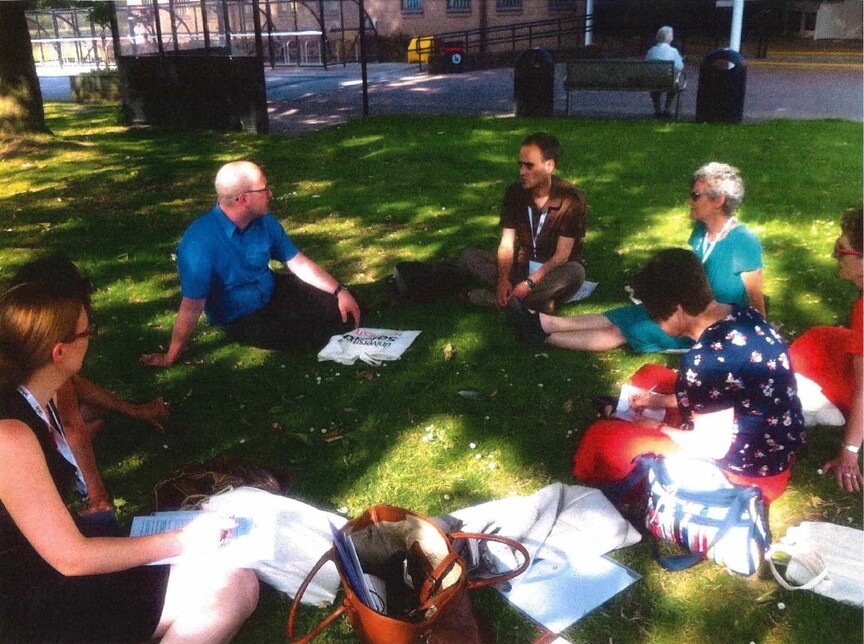
After an intensive collaboration with two Dutch colleagues from Radboud University, Jos Blom and Frans Korsten, I became acquainted with their young colleague Odin Dekkers. It was from Odin and his colleague Usha Wilbers (whom I did not know at the time), that I received this jubilant email message on 19 June 2009:
“Now that our grant application has been approved, we can schedule our first expert meeting, in which we will discuss the founding of the European Society for Periodical Research. Since this is our first meeting and we aim to get as much input as possible, we would like to invite both the core group members and the Advisory Board to Nijmegen. As you can see in the grant application (…), NWO will grant us 7000 EURO for this meeting, which means that we can hopefully cover everyone's travel and hotel expenses.”
Clearly, Usha and Odin deserve all the credit for this initiative. Their idea of a European Society for Periodical Research first emerged in 2008, during a successful workshop on periodical studies organized at the ESSE conference in Aarhus, Denmark. They thereafter applied for a grant with the Dutch Research Council (NWO) to support the launch of such an association. The application form mentioned Edinburgh Napier University and Salford University as European partners. The core members, hence founding members, listed on the application were: Peter Buse (Salford), Odin Dekkers (Radboud), Marysa Demoor (Ghent), Wolfgang Görtschacher (Salzburg), Alistair McCleery (Napier), Anthony Rowland (Salford) and Usha Wilbers (Radboud). The advisory board members were Margaret Beetham (Manchester), Ellen Garvey (New Jersey), Linda Gunn (Napier) and Sophie Levie (Radboud). Once the grant was awarded, Odin and Usha immediately set to work. The expert meeting of the founding members and advisory board members was set for the last week of November 2009, the last Thursday and Friday of that month. According to Usha’s minutes of the meeting, the focus of those days was to be divided as follows: first day: organization, scope and goals; second day: publications, conferences and collaborative projects
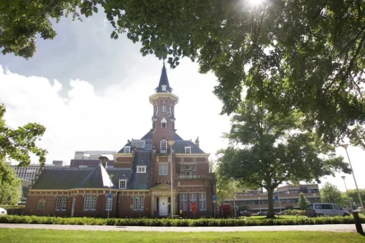
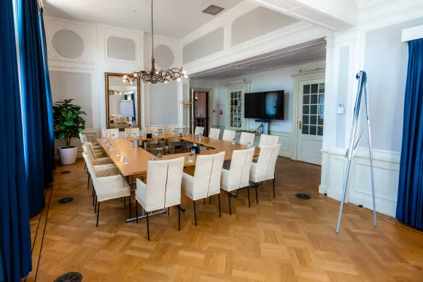
I was unable to attend the first day so I joined the meeting early on day two. The venue for this meeting was a small chateau on the premises of Radboud Universiteit, Huize Heyendael. I was extremely impressed by this building and its interior decoration (see illustrations).
Once in the meeting room, however, I was immediately engrossed in the discussion. The agenda for the meeting we had received earlier listed these items (the society had no definitive name then and was abbreviated as ESPR):
- the goals of the ESPR
- the practical organisation of the ESPR
- the conferences in Edinburgh and Salford
- publication possibilities
- the founding of a journal for European periodical research
- the website
- Ellen Garvey will share her experiences with the RSAP
- Goals: ESPR wanted to be different from existing research societies such as RSVP, RSAP and SHARP by being not only interdisciplinary but also multilingual. It was meant to advocate an interdisciplinary approach by focusing on “English and non-English language periodicals and transcending specific thematic interests”.
- Practical organisation: Members of the group such as Prof. Buse and Prof. Rowland hoped to ensure contact and collaborations with existing research groups. There were to be three expert meetings (Nijmegen (2009), Edinburgh (2010), and Salford (2011)).
- Conferences in Edinburgh and Salford: these plans were confirmed by the representatives present. The Edinburgh conference was eventually cancelled for unknown reasons and replaced by a conference at Ghent University.
- Publication possibilities: a handbook on the theory and methodology of periodical research was part of the future plans mentioned in the application.
- Plans for a journal were touched upon. The Journal of European Periodical Studies (JEPS), the online journal directly related to the Society was conceived and edited by Prof. Marianne Van Remoortel (Universiteit Gent) from 2016 until and including 2024. The journal is a bi-annual, peer-reviewed, online, open access journal published by Universiteit Gent. The current editor-in-chief is Prof. Cedric Van Dijck (Vrije Universiteit Brussel).
- The website was seen as an absolute necessity and launched as early as 2010. It was designed by Radboud Universiteit colleague, Astrid Bracke, and the ESPRit logo was designed by graphic designer Bas Krijn.
- Helen Garvey. Helen gave a overview of the organisation of the RSAP (Research Society of American Periodicals: the number of members, the scope, the function of the board etc.).
The agenda was briefly interrupted when a light lunch was wheeled in on a little table the appearance of which matched the splendid surroundings.
One of the main issues raised in the afternoon concerned the inclusion or exclusion of the nineteenth century. Some of the representatives whose work focused on the twentieth century argued that the nineteenth-century press was sufficiently supported by the Research Society of Victorian Periodicals. Both Margaret Beetham and myself countered that this would be a great loss to the new society and to periodical research, since RSVP focuses on English-language periodicals only and its members publish primarily in English. Besides, the nineteenth century is crucial: it is the era when periodicals emerged in vast numbers and in all sorts of formats. We were happy to see that our logic was quickly upheld by the others as well and so the nineteenth century remained securely in place.
Another, more creative matter of debate was the name of the new society. That discussion, however, was quickly concluded when most members expressed a preference for ESPRit. The chair did indicate that we all had some time to think of a better name but there was little reason to believe that a better name could be found. So ESPRit it became and still is.
We left for home that night feeling satisfied with a day well spent.