ESPRit was made in the Netherlands, with a few British and Belgian ingredients. It is still formally registered as a Society in the Netherlands, but according to Kristin Ewins’ chronicle of the organisation, the idea for ESPRit was first shaped in Denmark in August 2008. I was there, but I don’t remember the exact details of the discussion. It took place in and around the 9th meeting of the European Society for the Study of English held at the University of Aarhus, as part of a panel on ‘Research and the Literary Periodical: Theory and Methodology’, convened by Usha Wilbers and Odin Dekkers from Nijmegen University and my colleague Antony Rowland from the University of Salford. (see figure 1, and note error in Usha’s name).
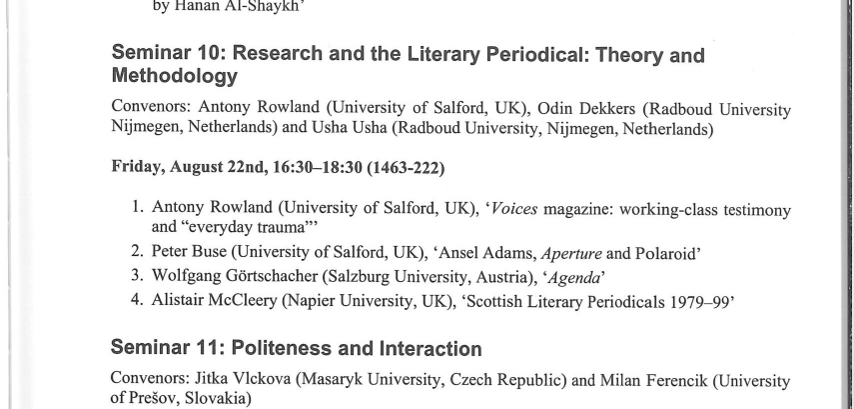
Figure 1. ESSE, 2008.
I gave a paper on the photography magazine, Aperture, which was definitely not a literary periodical. Whatever we discussed, Usha and Odin got things moving very quickly, securing 25,000 euros in network funding from the Dutch Research Council (NWO), setting up a mailing list, and organising a first ‘expert’ meeting in Nijmegen in 2009. As well as inviting the participants at the Aarhus conference to this meeting, Usha and Odin brought in as advisors major figures from the field of periodical studies, Margaret Beetham, Marysa Demoor and Ellen Garvey. Usha then visited Salford in 2010, with Margaret, Kristin Ewins, Brian Maidment and Matthew Philpotts joining the meetings where we planned the first ESPRit conference, Periodicals Across Europe. This was organised the following year by Kristin, Brian, Matthew and myself at the Anthony Burgess Foundation in Manchester, with funding from the Jean Monnet Centre. (see figure 2).
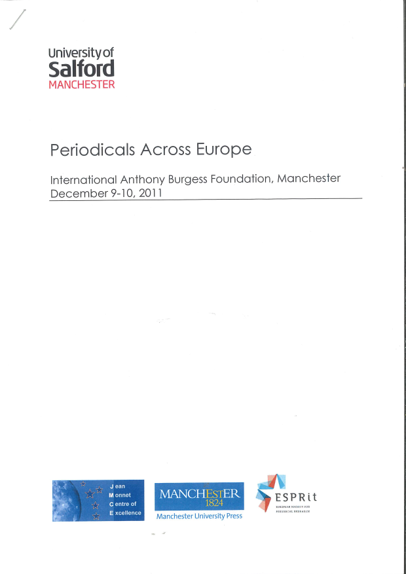
Figure 2. Periodicals Across Europe
The title of the inaugural conference signalled the comparativist, multi-lingual ambitions of ESPRit, as well as the recognition that periodicals do not respect borders in the networks that they build. Our keynotes were Sascha Bru, Sophie Levie, and Barbara Mittler, whose arrival times at Manchester airport are scribbled in my very poor penmanship in figure 3.
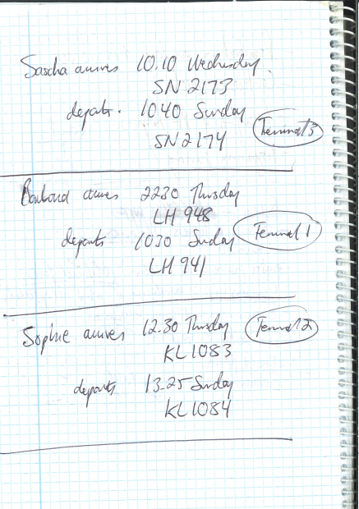
Figure 3. Flight arrival times for keynotes Sascha Bru, Barbara Mittler and Sophie Levie, 2011.
A second conference in Ghent in 2012 was followed by a second expert meeting at Media City in Salford in 2013, which included Laurel Brake, Evanghelia Stead and Marianne van Remoortel. (see figure 4).
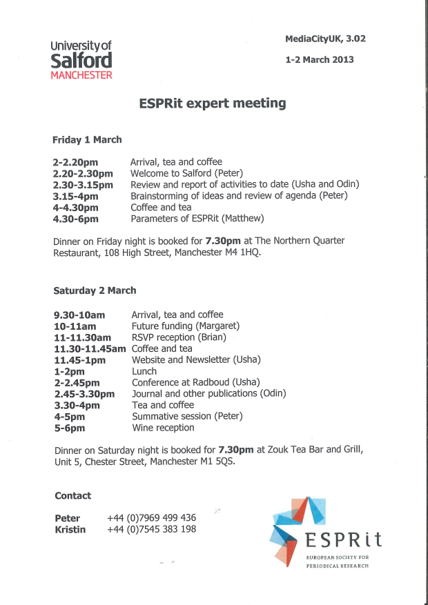
This meeting was where we decided we better professionalise ourselves a little. Up till then we had a logo and a mailing list, but no formal committee structure, no fees for membership and no formal status as a Society. I always liked the non-hierarchical, flat leadership structure of these early years, whose spirit I think continued as we gradually acquired a Board, a Chair, a constitution, and eventually even a bank account (in 2019). The idea for an open access journal was also conceived at this second expert meeting, with Marianne taking the lead.
None of this would have happened without the energy and know-how of Usha and Odin in the first years of the organisation, and I hope that the Dutch Research Council, looking at the results, feels it was money well spent. We were also very fortunate to have throughout the wise counsel and constant encouragement of representatives from two older societies, RSVP and RSAP, who could see the value of ESPRit and did not view it as a rival. I am personally especially grateful to my colleagues in the UK, Margaret Beetham, Laurel Brake and Brian Maidment.
