Keynote Speakers

Periodicals as Cultural Assemblages
Málaga, 3–5 September 2025

We are delighted to announce the keynote speakers for the 13th Annual ESPRit Conference. Their lectures will address central themes of the conference from distinct disciplinary and cultural perspectives.


Catherine Delyfer

University of Toulouse Jean Jaurès

Catherine_Delyfer.jpeg
Keynote Title: Testing the Generic Boundaries and Agency of the Periodical Form: Assembling The Magazine with Lucy Raeburn

Catherine Delyfer is Professor of English at the University of Toulouse Jean Jaurès and a member of the Centre for Anglophone Studies (C.A.S., EA 801). Her research focuses on Victorian literature and culture, art, gender studies, and the interplay between text and image in periodicals and illustrated books.

She is the author of Art and Womanhood in Fin-de-Siècle Writing: The Fiction of Lucas Malet, 1880–1931 and has co-edited multiple scholarly volumes and journal issues on aestheticism, intermediality, and gender. She currently serves as joint editor of Studies in Walter Pater and Aestheticism.

🔗 More about Catherine Delyfer


María Isabel Hernández Toribio

Complutense University of Madrid


Keynote Title: “Ciberpragmática y periodismo: las redes sociales de algunas publicaciones”

María Isabel Hernández Toribio is Senior Lecturer in Spanish Language at the Complutense University of Madrid. Her research lies at the intersection of pragmatics, discourse analysis, and digital communication, with recent work focused on speech act theory in online platforms.

She has published on digital discourse in contexts such as cultural institutions, tourism platforms, audiovisual media, and advertising. She is currently Academic Secretary of the Complutense Institute for the Teaching of Spanish and the Master’s in Creative Writing.

🔗 More about María Isabel Hernández Toribio


👉 Return to the Conference Main Page

JEPS in Conversation

Launched in 2025, JEPS in Conversation is a new online initiative designed to accompany each issue of the Journal of European Periodical Studies.

The series offers a space for editors and authors to engage directly with readers, discuss their research, and reflect on key questions shaping the field of periodical studies today. Each session highlights selected articles from the current issue and invites the audience into a live conversation on emerging themes, new methodologies, and collaborative directions in periodical research.

This is an open, informal space for dialogue: everyone interested in periodical studies is warmly welcome to attend.


Episode 1 – Periodicals & Belonging (20 June 2025)

Topic
This first episode explores how periodicals have historically constructed, maintained, or resisted notions of community and identity, and what that means in today’s global context.

Articles in focus:
🔹 “The Post-War Construction of a Sense of Belonging in Italian Film Criticism (1943–53)” by Stefano Locati — Read it
🔹 “On Post-Dictatorship, Popular Loquacity and Marginal Periodicals: Bananas, a Free Creation Magazine Based in Valencia (1979–1980)” by Inés Molina-Agudo — Read it

Speakers:
🔹Mary Ikoniadou, Andrew Hobbs, Annemarie McAllister (Issue Editors)
🔹Stefano Locati (IULM University of Milan)
🔹Inés Molina-Agudo (Universidad Autónoma de Madrid)


Listen to the Episode

You can now listen to the recording of Episode 1 here:
🎧 JEPS in Conversation – Periodicals & Belonging

Or browse all podcast episodes on the channel:
🎧 ESPRit on SoundCloud


About the Series

JEPS in Conversation is part of ESPRit’s broader mission to support and disseminate cutting-edge research in periodical studies.

Each session is recorded and made available for later listening.

Seminar series on transnational periodical research

This series of work-in-progress sessions is led by colleagues contributing to the Brill Handbook of Transnational Periodical Research, edited by Marianne Van Remoortel and Fionnuala Dillane. Seminar participants will each speak for 8-10 minutes on the challenges of ‘transnational’ work and on questions that their work-in-progress has raised to date.

The workshops aim to deepen and enrich understandings of what we mean by transnational periodical research, including considerations of the usefulness and limitations of the ‘transnational’. As work-in-progress sessions, we also hope to open up discussions about our methodologies and strategies as periodical researchers. Each session will be one hour long, conversational in format, and audience participation will be encouraged. Each workshop will be held on zoom and registration links are included below.

We look forward to seeing you and to the ongoing discussions.

Work-in-Progress Workshop 1: Monday 25 September 2023 with

  • Gábor Dobó and Merse Szeredi (Petőfi Literary Museum–Kassák Museum, Budapest) on Networks and the Avant-Garde
  • Henriette Partzsch (University of Glasgow) on Translation and Genres
  • Marguérite Corporaal (Radboud University) on Travelling Localism

Work-in-Progress Workshop 2: Monday 2 Oct 2023 with

  • Cedric van Dijck (Vrije Universiteit Brussel) on Empire
  • Stephan Pigeon (St Francis Xavier University, New Brunswick) on Scissors and Paste
  • Sukeshi Kamra (Carleton University, Ottawa) on Postcolonialism/Transimperialism

Work-in-Progress Workshop 3: Tuesday 10 October 2023 with

  • Sophie van den Elzen (Utrecht University) on Rebels
  • Sara Marzagora and Malak Abdelkhalek (King’s College London) on Internationalism, Solidarity and Pedagogy

Final Programme – Málaga 2025

We are pleased to announce that the final programme for the 13th Annual ESPRit Conference, Periodicals as Cultural Assemblages (Málaga, 3–5 September 2025), is now available.

You can read and download the programme here.

We look forward to welcoming you in Málaga.


👉 Return to the Conference Main Page


The ESPRit Prize

Since 2022, the European Society for Periodical Studies (ESPRit) has awarded the ESPRit Prize to recognize outstanding contributions to the field of European periodical studies. This biennial honorary award of €500 celebrates projects that have had a significant impact on the study of periodicals, fostering international collaboration and advancing research beyond national boundaries.

Who is Eligible?

Eligible projects include, but are not limited to:

✔️ Monographs and edited collections
✔️ Exhibitions and reference works
✔️ Serial publications and journal editorships
✔️ Websites and databases related to Periodical Studies

In the spirit of ESPRit, projects are not limited to the English language, but they must demonstrate a strong influence on European periodical studies beyond their country of origin.

Nominations & Submission

Projects must have been completed within the two years preceding the submission deadline. Nominees do not need to be ESPRit members, but their work should align with ESPRit’s scope (see here).

Nominations can be made by:
✔️ The project’s creator(s)
✔️ Fellow researchers nominating others
✔️ Jury members proposing eligible works

To submit a nomination, nominators must provide a 500-word proposal outlining the project and its impact. The next submission deadline would be at the beginning of 2026. Proposals should be sent to This email address is being protected from spambots. You need JavaScript enabled to view it..

Award Ceremony & Benefits

The ESPRit Prize is presented at the Annual Meeting, with winners invited to showcase their projects at the next ESPRit conference and on the ESPRit website. In addition to the monetary award, winners receive free ESPRit membership for one year.

For more details or to submit a nomination, contact This email address is being protected from spambots. You need JavaScript enabled to view it.

Winner ESPRit Prize 2024

We are pleased to announce the winner of the 2024 ESPRit Prize for digital projects and/or print research on periodicals in Europe published in 2022/2023.

Congratulations to Marysa Demoor, Cedric Van Dijck and Birgit Van Puymbroeck, editors of The Edinburgh Companion to First World War Periodicals (Edinburgh University Press, 2023), and to all contributing authors.

The ESPRit Prize committee was unanimous in their decision, calling the winning volume a “genuine tour de force”. The committee was “impressed by its vast scope and by the diversity of angles (critical, theoretical, thematic, national, linguistic) from which the different chapters consider the First World War press” and praised “the richness of scholarship produced, from its compelling attention to different critical methodologies, materialities of the press, genres, events and global perspectives”.

Joint Winners of the 2022 ESPRit Prize

The European Society for Periodical Studies (ESPRit) is pleased to announce the joint winners of the 2022 ESPRit Prize, recognizing outstanding contributions to the field of European periodical studies:

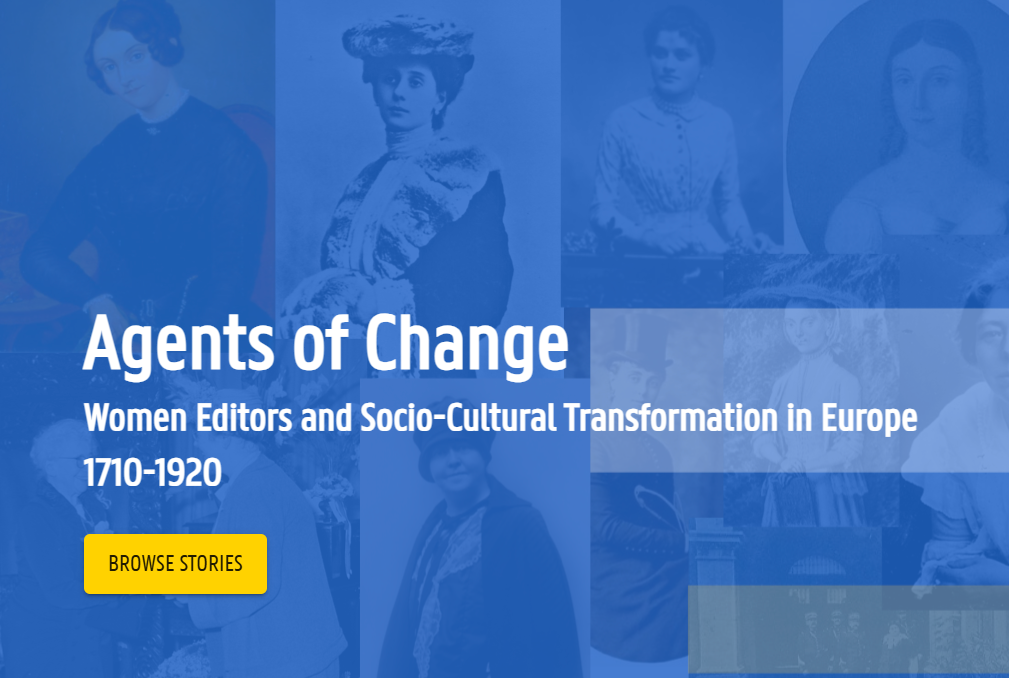
Agents of Change: Women Editors and Socio-Cultural Transformation in Europe, 1710-1920 / WeChangEd (www.wechanged.ugent.be)
Created by: Marianne Van Remoortel and team, Universiteit Gent

Serial Forms: The Unfinished Project of Modernity, 1815-1848
Author: Clare Pettitt, King’s College London (Oxford University Press)

Congratulations to the winners!

'Periodicals and the Law' Network seminar series

This seminar series was initially organised during the 2023-2024 academic year by Aled Jones and Gioula Koutsopanagou, supported by a sub-group comprising Mara Logaldo and Nora Ramtke, and it is currently in its fifth edition.

Its purpose is to create a network for the creation of collaborative, transnational and comparative work on press regulation and press practices in print and visual material in and across different national contexts with respect to the law, and to the law-related professions of journalists, lawyers, lawmakers. and legal periodicals.

Subjects may include:

  • IP and copyright in the context of the notion of protected work, such as printed and visual material (photographs and artworks)
  • moral rights (appropriation art, remixes)
  • ownership (authors and editors, printed matter, photographers, reporters)
  • exceptions and limitations (fair use), infringements, Creative Commons license, civil law protection (rights of privacy, right of publicity, personal data protection), fiscal policies, libel legislation, obscenity laws, state censorship, court injunctions, and state security restrictions (e.g. for national defence in wartime)

The field also includes studies of the persecution and prosecution of reporters, editors, writers and publishers, legal restrictions on ownership (e.g. anti-Trust, anti-monopoly laws), media laws covering advertising, laws covering reporter access (e.g. the UK Lobby system), or geographic areas/militarised zones of restricted access, and war reporting.

It is envisaged that work undertaken by researchers in their own institutions or individually, based on local/national collections, with an interdisciplinary approach, may then be considered in a broader, multinational context.

The online seminars will each last one hour and will consist of two papers of 15 minutes each, followed by discussion.

Recordings of past seminars are available below, organized by date, allowing you to explore topics of interest at your convenience. You may also watch them on YouTube.

P&L Seminar 8: Fifth Series

ANNA KALINOWSKA, ‘So far, yet so close. English newsbooks and the Polish-Lithuanian Sejm’, 19 February 2026. Chair: Aled Gruffydd Jones

The emergence of the periodical press in England was closely linked to Parliament, as the first newsbooks in the early 1640s focused on reporting events in Westminster when Parliament became a key institution in the country’s political life. When the editors expanded the scope of coverage to include foreign news, Poland-Lithuania and its Sejm became regular subjects of reports and comments for newsbook readers. In my presentation, I will discuss the most important elements of the coverage of the Polish-Lithuanian parliamentary system, with a particular focus on the legal aspects of its functioning and the manner in which news about the Sejm was contextualised within the domestic political landscape. Despite the geographical distance and the multitude of differences between the two countries, it is clear that the Polish-Lithuanian reality was well known to both the newsbook editors and their readership, and constituted a point of reference in the domestic political discourse that was so prominent at the time. 

Dr Anna Kalinowska is a Senior Researcher in the Institute of History at the Polish Academy of Sciences and Head of Publications at the Polish History Museum, as well as former Head of Historical Research at the Royal Castle, all in Warsaw. Her research interests are centred on the area of early modern diplomacy and news in the Polish-Lithuanian Commonwealth and in Western Europe, with a particular emphasis on newspapers. She is one of the organisers of the ‘Splendid Encounters’ conference series and a grantee of the British Academy, the Royal Society of Edinburgh and the US State Department (Fulbright Program). Most recently she was also a Fernand Braudel Fellow at the European University Institute in Florence.


MARINOS PAPADOPOULOS (Dr., Lawyer, specialized scientist and legal advisor): ‘AI and software legal protection’, 28 November 2025. Chair: Simona Laghi

The seminar will focus on the right of communication to the public and the making available right in relation to software. It will explore relevant EU legislation and draw on established case law concerning these rights, with particular attention to key legal concepts such as the notion of the “public.” The presentation will also address the protection of software under EU law, outlining the exclusive rights granted to software rightholders and examining how the right of communication to the public is exercised in practice. Part of the seminar will be dedicated to the intersection of software and artificial intelligence, highlighting common AI components and the legal mechanisms available for their protection. Additionally, the presentation will touch upon the challenges software developers face when attempting to secure patents under European law, metaphorically described as the "needle's eye" through which they must pass.

Marinos Papadopoulos is a Lawyer, registered with the Athens Bar Association since 1996. Ever since he practices Law and participates in national and international forums related to Law and Technology. From 2016 to 2024, he was legal advisor to the National Library of Greece for Copyright, Contract Law, Transparency and Open Access in the new era of the National Library at the Stavros Niarchos Foundation Cultural Centre. He served as legal advisor to the World Bank Group on legal issues related to the implementation of the new Judicial Map of the Greek Justice system. He has extensive experience as a specialized scientist and legal advisor in innovation projects funded by the European Commission and implemented in Greece and abroad. Works authored by him on legal issues of Law and Technology have been published in academic and scientific publications in Greece, the USA, the United Kingdom, Australia and India.


P&L Seminar 7: Fourth Series

CELINE MANSANTI (University of Picardie-Jules Verne): ‘La Vie Parisienne in the 1920s US: “New Puritanism”, Censorship and Self-Censorship’, 23 June 2025. Chair: Andrew Hobbes

This presentation is based on a work in progress on the cultural transfer of La Vie parisienne and other humorous French magazines (such as Le RireLe SourireLe Journal amusant, etc.) to the US between 1913 and 1939. Cumulatively attracting millions of French readers during the Belle Époque (roughly between the 1870s and 1914), these French light, comic, risqué, satirical illustrated magazines had a rich, second, later life in the US where they contributed to massive reactions against the “new Puritanism” (Mencken) prevailing in the American society. In particular, they helped reshape the magazine landscape when “sex o’clock” (Current Opinion, vol. 55, n°2, August 1913) started to chime around 1913, contributing, in the 1910s, to the modernization of the triad of classic humor magazines (PuckJudgeLife) and helping a “smart” magazine such as Vanity Fair find its distinctive, sophisticated voice; encouraging the creation of a set of small humorous magazines in the 1920s (such as French Frolics La Vie ParisienneFrench Humor, Joe Burten’s magazines); and taking part in the birth of a whole line of French-themed spicy pulps (such as Parisienne MonthlyGay ParisienneParis Nights, and La Paree Stories), mostly in the 1930s. In this talk, I will focus on La Vie parisienne and show how, in the 1920s, this magazine inspired several American publications (fully-fledged magazines or “Vie parisienne” issues of existing magazines) committed to fighting “new Puritanism”. A good number of these publications printed approximate copies of La Vie parisienne’s risqué illustrations, triggering censorship actions reported in the press. Censorship in turn generated self-censorship phenomena. Studying how censorship operations were reported in the press of the time and comparing some of the original illustrations published in La Vie parisienne with those copied in these American publications should help us highlight some of the censorship and self-censorship mechanisms in the “new Puritan” America of the 1920s and see that the “Roaring Twenties” did not roar for everyone everywhere.

Céline Mansanti is an associate professor in American history at the University of Picardie-Jules Verne in France. She wrote her PhD thesis on transition magazine (La revue transition, 1927-1938, le modernisme historique en devenir, Rennes, PUR, 2009). Her field of interest is the cultural history of the United States and its relationships with Europe in the first half of the 20th century, with a special focus on periodicals. She is currently writing a manuscript entitled “‘Sex O’Clock in America’: The cultural transfer of La Vie parisienneLe Rire, and other French humorous magazines to the US, 1913-1939”.


BEATRICE JOYEUX-PRUNEL (University of Geneva): 'The Legal Labyrinth of Image-Based Research: Insights from the Visual Contagions Project', 23 May 2025. Chair: Gábor Dobó

Copyright law remains one of the most frustrating obstacles for art historians—especially for those working with illustrations from periodicals, and even more so when dealing with large-scale digitized corpora. At the heart of the issue lies a challenge: identifying, dating, and locating the publication of images. Drawing on the Visual Contagions project—a research initiative on globalization through images in the 19th and 20th centuries—this presentation will highlight key moments where legal considerations around copyright (including reproduction, dissemination, and data mining) must be taken into account. It will also outline some of the strategies developed to navigate these constraints.

Béatrice Joyeux-Prunel is a full professor at the University of Geneva, Chair of Digital Humanities. She leads the Visual Contagions project, funded by the Swiss National Science Foundation, which focuses on the global circulation of images in the 20th century. A specialist in artistic and cultural globalization, she is widely recognized for her trilogy on the global and social history of avant-gardes, published by Gallimard (paperback: volumes 1 and 2) and CNRS Editions (volume 3) (English translation in progress for Brill publishings). Last publication: L'Art contemporain. Une infographie, with Guillemette Crozet (Paris:CNRS Editions, 2024).


P&L Seminar 6: 'Machine Learning Meets Victorian Media'

THOMAS SMITS (University of Amsterdam): 'Machine Learning Meets Victorian Media: Tracking Transnational News Images', 25 November 2024. Chair: Nora Ramtke

This presentation explores the transnational circulation of images in nineteenth-century periodicals using computational methods. While images were crucial to the period's periodical press, tracing their movement across publications, languages, and national boundaries has long challenged researchers. By applying machine learning techniques to match illustrations between the famous American periodical Frank Leslie's Illustrated Newspaper and several major European journals, this research demonstrates new possibilities for analyzing cross-cultural media exchange. It uncovers a complex network of artistic and technological transfer, illuminating the movement of entrepreneurs, illustrators, engravers, and visual content across national borders. This presentation is based on joint work with Paul Fyfe.

Dr. Thomas Smits is assistant professor of digital history and AI at the University of Amsterdam. A historian with an interest in visual culture and computer-assisted methodologies, he is the author of The Visual Memory of Protest (AUP, 2023), which he co-edited with Ann Rigney, and the prize-winning The European Illustrated Press and the Emergence of a Transnational Visual Culture of the News, 1842–1870 (Routledge, 2020). Recent work has been published in Humanities and Social Sciences CommunicationsVisual StudiesNew Media & Society, and Digital Scholarship in the Humanities. More information: thomassmits.eu.


P&L Seminar 5: 'Entitling the Woman Writer'

TEJA VARMA PUSAPATI (Shiv Nadar Institution of Eminence): 'Entitling the Woman Writer: The 1842 Copyright Act and The Female Journalist in Eliza Meteyard’s Struggles for Fame (1845)', 2 October 2024. Chair: Cedric Van Dijck

Struggles for Fame (1845), a novel by the radical woman journalist Eliza Meteyard (1816–1879) offered one of the earliest fictional representations of the female journalist. The novel’s episodic plot follows the fortunes of Barbara, who, after being saved from ruffians at the age of two, lives with various guardians, including an abusive parish nurse, a wealthy gentleman, a captain who tries in vain to make her a musician, and a packman turned bookseller named Adam Leafdale. Determined to earn her living by writing, Barbara wages a hard and occasionally lonely struggle with the conditions of the literary market, contributing to various ill-paying periodicals and newspapers before shifting to book writing and becoming a celebrated woman of letters. Barbara’s struggles also draw attention to the failure of the recently passed copyright legislation to safeguard the interests of periodical contributors. The Copyright Act of 1842, which, for the first time, extended authors’ copyright beyond their lifetime, supported the idea that the best of authors were likely to receive their due from the market gradually and over a long period. As various scholars have shown, the very notion that an author had proprietary rights over his/her production was historically based on an understanding of the writer as an inventor of a novel idea. Since journalists worked collaboratively, and often under direct instructions from periodical editors and owners, it was particularly difficult to identify the source of originality and to treat the periodical writer as the sole creator of a literary work. My presentation will focus on this crucial, neglected novel and elucidate its representation of the literary market, conditions of authorship, and the professionalisation of women writers in the wake of the 1842 Copyright Act.

Teja Varma Pusapati is Associate Professor in the Department of English at Shiv Nadar Institution of Eminence, India. She has held a TORCH Women in the Humanities writing fellowship at the University of Oxford and an Andrew Mellon Fellowship at the Huntington Library in California. She has served on the Board of Directors of the Research Society for Victorian Periodicals. Teja’s work has appeared in the journals Victorian Periodicals ReviewWomen’s Writing and Nineteenth-Century Gender Studies. She has contributed book chapters to Women, Periodicals and Print Culture in Britain 1830s-1900 and the Routledge Companion to Literature and Feminism. Her first monograph, Model Women of the Press: Gender, Politics and Women’s Professional Journalism, 1850-1880, was recently published by Routledge, New York.


P&L Seminar 4: 'Periodicals and AI'

ELENA LAGOUDI (Museologist/Data curator, National Documentation Centre, Athens, Greece): 'Cultural Data in the AI Age: navigating the intersection of cultural datasets, civic value, and AI', 28 May 2024. Chair: Elena Ogliari

The National Documentation Centre (EKT) in Greece, through SearchCulture.gr, the Greek national aggregator for cultural data, plays a pivotal role in widening public access to cultural data in Greece and beyond. This paper will present SearchCulture's content, innovative business model and digital curation methodology which is oriented towards adding social value to cultural data produced through public funding. It will discuss cultural datasets, with a focus on Periodicals, and how AI can revolutionize cultural documentation. It will delve into the benefits of using AI throughout the data lifecycle, from preservation to analysis, highlighting its potential for enhancing understanding and representation of the past.

Elena Lagoudi is a museologist with a focus on data curation, collections management and digital content strategy. Having worked for a decade in national museums in the UK (TATE, The National Gallery) she developed digital products, services, and strategy. Since 2012 she has been working for the National Documentation Centre in Athens, Greece, as part of the team that develops the National Cultural Heritage Aggregator, SearchCulture.gr.

 EVANGELIA VAGENA (Attorney at Law, Ph.D.): 'AI, Copyright Law in print and visual media', 28 May 2024. Chair: Elena Ogliari

We will examine the intersection of artificial intelligence (AI) and copyright law, with a focus on its implications within the realms of academic journals, legal literature and images' use within. We will focus on AI's role in content creation, curation, and dissemination which has significantly transformed scholarly publishing and legal documentation processes, as well as in the rights’ management process. AI evolution presents multifaceted copyright challenges concerning ownership, infringement, and the application of copyright exceptions, both in AI's input and output. In light of the first EU AI Act, we will examine the main questions posed and the responses provided by current copyright legislation, as well as those addressed by emerging AI-specific laws. Additionally, we will underscore the importance of interdisciplinary dialogue among the legal community, technologists, and policymakers.

Evangelia Vagena is a lawyer specializing in IT law with a focus on copyright law, personal data and cybersecurity. Currently, she serves as the Senior Director of Compliance for the Orfium Group of Companies. From 2019 to 2022, she held the position of Director at the Hellenic Copyright Organisation (HCO), where she had previously worked as a lawyer for 13 years. She earned her PhD from the Athens School of Law, focusing on copyright technological protection and digital rights management. Additionally, she holds a Master's degree in Law and Information Technology from the University of Montpellier I in France. Evangelia is also an adjunct lecturer of Information Law at the Athens University of Economics and Business and a lecturer on contract at the University of Piraeus.


P&L Seminar 3: 'Periodicals and the Right to Copy'

WILL SLAUTER (Sorbonne Université): 'Periodicals and the Right to Copy: Copyright Exceptions for the Press Before and After the Berne Convention (1886)', 24 April 2024. Chair: Andrew King

This presentation will explore the history of copyright exceptions for the periodical press in the decades immediately before and after the Berne Convention for the Protection of Literary and Artistic Works (1886 and subsequent revisions). Comparing national legislation in several European countries and early bi-national copyright treaties as well as the various revisions of the Berne Convention, it will draw attention to contemporary debates about the appropriate rules for the reproduction and translation of contributions to newspapers and other periodicals. Although the history of copyright is most commonly framed as a narrative of expansion over time, the history presented here stresses how in specific national and international contexts there were successful efforts to carve out an explicit right to copy articles from newspapers and other periodicals. Although the broad rights to reproduce material from periodicals found in some of the national statutes and the initial Berne Convention were restricted over time, the history presented here shows how attitudes and practices related to periodical works helped nudge copyright law in specific directions at key moments in its history.


P&L Seminar 2: 'Beyond the Taxes on Knowledge'

ANDREW KING (University of Greenwich): 'Beyond the Taxes on Knowledge: the Law and the 1860s English Press', 19 December 2023. Chair: Aled Jones

Summed up in Carlyle’s famous notion of the press as “the Fourth Estate”, discussions of the Law and the British press in the nineteenth century have often been framed in gendered terms of a heroic struggle for freedom from government where opposition to the so-called “Taxes on Knowledge” from the 1830s to 50s has been a focal point. However, regulation of the press is conceptually much more complex than one issue or slogan (however effective such a unifying slogan can be). The laws concerning the press are many and varied, involving diverse actants in a multitude of conflicts on small and large scales: government and legislature (not always identical); owners and managers (again, maybe with different and conflicting aims); workers of many different kinds in manufacturing and distribution; consumers. I shall briefly relate a few case studies concerning some of the remaining legal regulations of the press in the 1860s after the last of the “Taxes on Knowledge” had been repealed in 1861, legal regulations concerning obscenity, libel, copyright, and – very often forgotten altogether – the labour conditions of both printers and distributors.


P&L Seminar 1: 'Periodicals and the Press'

JELENA LALATOVIĆ (Institute for Literature and Art, Belgrade): 'Campaigning Against State Repression in the Periodical Press: Censorship and Resistance in the Yugoslav Context (1928˗1938)', 17 November 2023. Chair: Nora Ramtke

In 1928 a prominent Yugoslav writer August Cesarec issued a newspaper The Protection of a Human: an Independent Herald for Human and Civil Rights aimed at campaigning against the Law for the protection of the state, whose main goal was to curb free speech and freedom of expression in the Kingdom of Yugoslavia. The newspaper The Protection of a Human thus represents the first periodical of this genre (entirely dedicated to a single cause) in the history of Yugoslav periodicals. Additionally, it established a specific rhetoric of defending the position of the free press, specifically in the genre of reporting. The aim of the research is twofold. Firstly, I would like to explore how the left-wing periodical press of the thirties, which were succumbed to severe censorship and persecution by the authorities, inherited and developed the strategies and tactics set as an example by Cesarec’s newspaper. Along with that, I would like to elaborate on whether this analysis allows us to outline a new classification of these periodicals on the basis that they cherished a specific meta-dimension embodied in their rhetoric and editorial underpinnings – deliberation on the position of the press in an authoritarian society. In other words, I use the Yugoslav context as a case study to examine how the legal framework (including the pretexts such as a libel or offense to restrain the freedom of expression) influenced the typology and morphology of the socially and politically engaged periodicals. The methodology I use relies on a comparative reading of the rhetoric and practice of censorship, which includes an examination of the archival documents of the Central Press Bureau, and periodicals whose editorial policy was based on a systematic opposition to repression and censorship.

MICHAEL LÖRCH (Researcher and translator): 'Decentralized Censorship in a Centralized State: The "Guidance and Control" of Scholarly Periodicals in the German Democratic Republic', 17 November 2023. Chair: Nora Ramtke

The 1949 constitution of the German Democratic Republic boldly declared in its 9th article that “There is no press censorship”. The country’s second constitution of 1968 avoided the taboo word of ‘censorship’ altogether, declaring instead that the “Freedom of the press, radio and television is guaranteed”. Consequently, there would never be any official law or regulatory text detailing the practice of censorship taking place in the East German state. Instead, the heavily centralized country relied on a decentralized system of ‘control and guidance’, transferring much of the responsibility on individual editors, authors, and other media professionals. Those, however, could, for most of the time, not rely on any document and instead had to anticipate what Party officials deemed printable, creating an atmosphere of mistrust and uncertainty. The practice of censorship therefore took place in a legal grey area, with State and Party relying on the use of euphemisms such as ‘guidance’, ‘control’ and ‘support, framing acts of censorship as sponsorship or the result of economic shortages. Much of the censorship therefore occurred in the form of pre- and self-censorship. The lack of a written law nonetheless created some leeway that resourceful editors and authors could carefully exploit. While these mechanisms have been subject of scholarly interest regarding the country’s book, newspaper and film production, the effect on periodicals has so far been neglected. This paper will therefore illustrate the ‘guidance and control’ exerted on even the most peripheral periodicals by looking at the Zeitschrift für Anglistik und Amerikanistik (1953-present), a scholarly journal of the humanities. Based on the journal and archival material, I will explore how the journal’s editors navigated this system of censorship without a censorship authority and how it influenced the journal and its contents. I will equally investigate how the journal participated in a wider movement, involving various forms of published and unpublished material, to widen the country’s literary canon and academic horizon, for which the ZAA’s international visibility and the very form of the scholarly journal provided opportunities and justifications.


 

JEPS 7.2 (2022): Periodical Formats in the Market

Volume 7 • Issue 2 • 2022 • Periodical Formats in the Market

Special Issue

Ramtke | Periodical Formats in the Market: Economies of Space and Time, Competition and Transfer | Journal of European Periodical Studies (ugent.be)

Nora Ramtke, Mirela Husić and Christian A. Bachmann

 2023-02-08  Volume 7 • Issue 2 • 2022 • Periodical Formats in the Market • 1–7

Norrick-Rühl | Periodicity, Subscription, and Mass Circulation: Mail-Order Book Culture Reconsidered | Journal of European Periodical Studies (ugent.be)

Corinna Norrick-Rühl

 2023-02-08  Volume 7 • Issue 2 • 2022 • Periodical Formats in the Market • 8–25

Fröhlich | Logics of Re-Using Photographs: Negotiating the Mediality of the Magazine | Journal of European Periodical Studies (ugent.be)

Vincent Fröhlich, Alice Morin and Jens Ruchatz

 2023-02-08  Volume 7 • Issue 2 • 2022 • Periodical Formats in the Market • 26–51

Mayer | Girls Girls Girls Girls Girls: The Trans-Atlantic Mass Magazine Culture of the 1920s as a Gendered Affair | Journal of European Periodical Studies (ugent.be)

Ruth Mayer

 2023-02-08  Volume 7 • Issue 2 • 2022 • Periodical Formats in the Market • 52–73

Gretz | From Pure Art to Sheer Luxury: Magazines as Ornamental Constellations and the Emergence of Aesthetic Capitalism in the Early Twentieth Century | Journal of European Periodical Studies (ugent.be)

Daniela Gretz and Marcus Krause

 2023-02-08  Volume 7 • Issue 2 • 2022 • Periodical Formats in the Market • 74–96

Ernst | Outside the Mainstream Press: Language, Materiality, and Temporality in Microzines | Journal of European Periodical Studies (ugent.be)

Jutta Ernst, Sabina Fazli and Oliver Scheiding

 2023-02-08  Volume 7 • Issue 2 • 2022 • Periodical Formats in the Market • 97–114

Neuffer | In Time: Periodical Theories and Philosophies of History in the Nineteenth and Twentieth Centuries | Journal of European Periodical Studies (ugent.be)

Moritz Neuffer

 2023-02-08  Volume 7 • Issue 2 • 2022 • Periodical Formats in the Market • 115–129

Articles

Vanacker | Fashioning ‘Belgian’ Literature and Cultural Mediatorship in the Journal littéraire et politique des Pays-Bas autrichiens (1786) | Journal of European Periodical Studies (ugent.be)

Beatrijs Vanacker, Charlotte van Hooijdonk, Vanessa Van Puyvelde and Tom Verschaffel

 2023-02-08  Volume 7 • Issue 2 • 2022 • Periodical Formats in the Market • 130–146

Field Notes

Stead | European Periodical Research 2020–30: Voices and Visions from the ESPRit 2021 Roundtable | Journal of European Periodical Studies (ugent.be)

Evanghelia Stead, Fionnuala Dillane, Jutta Ernst, Fabio Guidali, Mara Logaldo and Jens Ruchatz

 2023-02-08  Volume 7 • Issue 2 • 2022 • Periodical Formats in the Market • 147–163

Reviews

Stoeger | Review of Gowan Dawson, Bernard Lightman, Sally Shuttleworth, and Jonathan R. Topham, eds, Science Periodicals in Nineteenth-Century Britain: Constructing Scientific Communities (2020) | Journal of European Periodical Studies (ugent.be)

Alexander Stoeger

 2023-02-08  Volume 7 • Issue 2 • 2022 • Periodical Formats in the Market • 164–166

Mussell | Review of Clare Pettitt, Serial Forms: The Unfinished Project of Modernity, 1815-1848 (2020) | Journal of European Periodical Studies (ugent.be)

James Mussell

 2023-02-08  Volume 7 • Issue 2 • 2022 • Periodical Formats in the Market • 167–170

JEPS 6.2 (2021): Modernity and National Identity in Popular Magazines

Special issue of the Journal of European Periodical Studies Vol 6 No 2 (2021): Modernity and National Identity in Popular Magazines

Table of Contents

SPECIAL ISSUE

Tim Satterthwaite, Online Conferences: A New Paradigm for Periodical Studies?

Carey Snyder, The Global Dialogics of the New Age

Phaedra Claeys, Individual Responsibility for the Common Cause? Everyday Preservationism in the Interwar Russian Émigré Newsmagazine Illyustrirovannaya Rossiya

Elena Ogliari, The Past Contains a Promise of Regeneration: Narratives of Ireland’s Future in Early-Twentieth-Century Juvenile Periodicals


Chara Kolokytha, Le Génie du Nord: Sélection and the Advocacy of a Cosmopolitan Northern Culture

Anne Reynes-Delobel, An Impossible Task? Reconciling Europeanism and National Popular Culture in Caliban (1947–51)

ARTICLES

Tijl Nuyts, Veerle Fraeters, Mediating Medieval Mystical Literature in Interwar Belgium: The Histoire Croisée of Hadewijch’s ‘First Vision’ in the Periodical Hermès (1933–39)

Christian A. Bachmann, Nora Ramtke, Planning Virtual Conferences in the Humanities: A Detailed Look at the 9th International ESPRit Conference

REVIEWS

Sofia Prado Huggins, Review of David Finkelstein, ed., The Edinburgh History of the British and Irish Press: Expansion and Evolution, 1800–1900 (2020)

Sze Wah Sarah Lee, Review of Faith Binckes and Carey Snyder, eds, Women, Periodicals, and Print Culture in Britain, 1890s–1920s: The Modernist Period (2019)


Alison E. Martin, Review of Andreas Beck, Nicola Kaminski, Volker Mergenthaler, and Jens Ruchatz, eds, Visuelles Design: Die Journalseite als gestaltete Fläche / Visual Design: The Periodical Page as a Designed Surface (2019)

John Morton, Review of Joanne Shattock, ed., Journalism and the Periodical Press in Nineteenth-Century Britain (2017/2019)


Maaike Koffeman, Review of Evanghelia Stead, Sisyphe heureux. Les revues artistiques et littéraires, Approches et figures (2020)

Call for submissions – JEPS 10.2 Open Issue

The Journal of European Periodical Studies invites submissions for its Open Issue 10.2 (Winter 2025). JEPS is a bi-annual, peer-reviewed, diamond open access journal published by Ghent University and the flagship journal of ESPRit, the European Society for Periodical Research. JEPS publishes articles on any aspect of the study of periodicals (magazines, newspapers, and other periodical publications) in Europe — in its broadest sense — from the seventeenth century to the present. 
 
For the Open Issue, JEPS welcomes a wide range of critical, theoretical, and methodological perspectives on the periodical press, including, but not limited to, history, literary studies, art history, visual culture, gender studies, media studies, history of science, and digital humanities. We particularly welcome submissions that consider European periodicals in a broader transnational, cross-language, cross-period, or interdisciplinary context. 
 
Papers should be between 5,000 and 8,000 words, prepared according to the JEPS author guidelines, and submitted through the online submission portal at https://openjournals.ugent.be/jeps/.
 
Deadline for submissions: 1 December 2025
 
JEPS articles: some highlights

1. Céline Mansanti, “Mainstreaming the Avant-Garde: Modernism in Life Magazine (New York, 1883–1936).” Journal of European Periodical Studies, 1.2 (Winter 2016). https://openjournals.ugent.be/jeps/article/id/71535/
 
2. Marie Nedregotten Sørbø, “Fourfold Female: Birgithe Kühle’s Pioneer Norwegian Journal Provincial-Lecture (1794) and Her European Book Collection”, Journal of European Periodical Studies, 6.1 (Summer 2021) . https://openjournals.ugent.be/jeps/article/id/71467/
 
3. Fabio Guidali, “Developing Middlebrow Culture in Fascist Italy: The Case of Rizzoli’s Illustrated Magazines” Journal of European Periodical Studies, 4.2 (Winter 2019). https://openjournals.ugent.be/jeps/article/id/71485/
 
4. Johanne Slettvoll Kristiansen, “Newspaper Debates in Late Eighteenth-Century England: ‘Letters to the Editor’ versus the Political Pamphlet.” Journal of European Periodical Studies, 6.1 (Summer 2021). https://openjournals.ugent.be/jeps/article/id/71481/
 
5. Jeroen Vanheste, “The Reconstruction of the European Mind: T. S. Eliot’s Criterion and the Idea of Europe.” Journal of European Periodical Studies, 3.2 (Winter 2018). https://openjournals.ugent.be/jeps/article/id/71499/

General Series

General Series seminars feature keynote lectures, panel discussions, and individual presentations that explore the historical, cultural, and social significance of periodicals across different periods and regions.

Sessions in this series are designed to engage a broad audience, fostering discussions that contribute to the evolving field of periodical research.

If you would like to propose a seminar to ESPRit, please contact the Coordinator of Online Seminars, Bénédicte Coste (Université de Bourgogne) at This email address is being protected from spambots. You need JavaScript enabled to view it..

Seminar recordings

Recordings of past seminars are available below, organized by date, allowing you to explore topics of interest at your convenience.

You may also watch them on YouTube.


 3 March 2023 Knowledge transfer and materiality in and around avant-garde journals

  • Gábor Dobó (Kassák Museum–Petőfi Literary Museum, Budapest), ‘Comrades and censors: Tracing implied and actual readers of radical periodicals during the interwar period’
  • Merse Pál Szeredi Dobó (Kassák Museum–Petőfi Literary Museum, Budapest), ‘No clichés. Conflicting aspects of knowledge production and printing techniques of avant-garde periodicals’

Chair: Barbara Winckler, Westfälische Wilhelms-Universität Münster

3 February 2023 Spaces of Translation: European Magazine Culture, 1945-1965

The members of the research group Spaces of Translation share some of the results from the project.

  • Alison E. Martin (Johannes Gutenberg-Universität Mainz)
  • Marina Popea (Nottingham Trent University)
  • Dana Steglich (Johannes Gutenberg-Universität Mainz)
  • Andrew Thacker (Nottingham Trent University)

Chair: Mara Logaldo, Università IULM

20 January 2023 New Computational Approaches to Periodical Studies

  • Thomas Smits (Antwerp University): 'Distant Viewing the Illustrated World of the Illustrated London News, 1842-1900'
  • Kaspar Beelen (Alan Turing Institute, UK), 'Mining Victorian Metadata. A computational analysis of historical press directories'
  • Ben Lee (University of Washington), 'Newspaper Navigator: Reimagining Digitized Newspapers with Machine Learning'

Chair: Peter Buse, University of Liverpool

 8 December 2022 Joint RSVP/Esprit Online Seminar on The Foreign Language Press

With speakers from TransfoPressthe Transnational network for the study of foreign language press from the 18th-20th century:

  • Diana Cooper-Richet (Université Paris-Saclay): "The Transfopress network (2012-2022): object, activities, publications"
  • Jennifer Hayward (Wooster college, Ohio) and Michelle Prain (Universidad Adolfo Ibànez, Valparaiso): "The English-Language press in Chile: 19th Century global networks to 21st Century digital dialogues"
  • Nicolas Pitsos (BULAC/Université Paris-Saclay): "The foreign-language press and the emergence of a polyphonic capital: the case of Paris"
  • Isabelle Richet (Université Paris Cité): "Helen Zimmern and the Italian Gazette: the editor as cultural go-between"

Chair: Fionnuala Dillane, University College Dublin

17 June 2022 Seminar Series: Sources beyond the periodical text

  • Nora Ramtke (Ruhr-Universität Bochum), ‘Europa (1835-1844) and its Supplements: Archiving the Abundance’
  • Hannah Connell (King’s College London and British Library), ‘Uncovering the relationships between periodicals through editorial correspondence: Networks of Russian-language emigre periodicals in interwar Paris’

Chair: Mara Logaldo, Università IULM

 13 May 2022 Seminar Series: Sources beyond the periodical text

  • Zsuzsa Török (Research Centre for the Humanities, Institute for Literary Studies, Budapest), ‘Sources for Anonymous Contributors to Periodicals: The Case of the Hungarian Stephanie Wohl and The Scotsman
  • Levente T. Szabó (Babeș-Bolyai University), ‘Reconstructing the Entangled History of the First International Journal of Comparative Literary Studies’

Chair: Peter Buse, University of Liverpool

10 December 2021 Seminar Series: Crossover influences and local identities of the popular illustrated periodicals of the nineteenth and twentieth centuries

  • Yelizaveta Raykhlina (New York University), 'From Paris to the Russian Provinces: Russian-language Fashion Magazines of the late 1830s and 1840s as Domains of Cultural Adaptation and Women’s Entrepreneurship'
  • Effrosyni Zacharatou (Athens School of Fine Arts), 'From Europe to Greece: The illustrated magazine as a distinct form'

Chair: Aled Jones, Panteion University, Athens

  •  Susann Liebich (Heidelberg University), 'A New Zealand ‘quality magazine’: The Monocle, 1937-1939'
  • Felix Larkin, 'Periodicals and Journalism in Twentieth-Century Ireland'

Chair: Peter Buse, University of Liverpool

5 November 2021 Keynote Lecture

  • Evanghelia Stead (Institut Universitaire de France / Université de Versailles), 'Exploring Periodicals through Images and Networks'

Abstract: Supported by individual investigation and collaborative work, the presentation offers a comparative and interdisciplinary approach to periodicals. It broaches the beneficial effects of collective exchange, and flags up some of the counter-productive effects and burdens. It embraces not so much strict methodologies as tactics and ploys to variously approach such a varied and complex field. The talk first discusses visual studies and interdisciplinarity. There follows an overview of group work on periodical networks, stressing the importance of relational dynamics. It further shows the preconceptions and limitations behind such expressions as “little magazine” and the recurrent split separating big mags from small reviews. Its conclusion reasons why periodicals are so fascinating and invites further discussion.

Chair: Maaike Koffeman, Radboud University

14 May 2021 Seminar Series: Crossover influences and local identities of the popular illustrated periodicals of the nineteenth and twentieth centuries

  • Patrick Rössler (University of Erfurt), “From Simplicissimus to Simplicus and Der Simpl. Satire magazines between Nazi gleichschaltung and exile, 1934-35”
  • Mary Ikoniadou (University of Central Lancashire), “Refugee publishing. The case study of the Greek political refugees in East Germany. Imaginings and aesthetics of repatriation amidst Cold War borders”

Chair: Andrés Mario Zervigón, Rutgers University

16 April 2021 Seminar Series: Crossover influences and local identities of the popular illustrated periodicals of the nineteenth and twentieth centuries

  • Júlia Fazekas (ELTE University, Budapest), “Popularity of Hungarian and European fashion magazines in the 1840s”
  • Charlotte Lauder (University of Strathclyde and National Library of Scotland), “Pithy people: the People’s Friend, a national magazine for Scotland”

Chair: Sophie Oliver, University of Liverpool


26 March 2021 Keynote Lecture

  • Victoria Kuttainen (James Cook University, Australia): “Portholes, Channels, and Seductions: The Messy Affordances of Antipodean Periodical Scholarship”

Chair: Peter Buse, University of Liverpool University

JEPS 6.1 (2021): Women editors in Europe

Special issue of the Journal of European Periodical Studies Vol 6 No 1 (2021): Women editors in Europe

Table of Contents

SPECIAL ISSUE

Marianne Van Remoortel, Julie M. Birkholz, Maria Alesina, Christina Bezari, Charlotte D'Eer, Eloise Forestier, Women Editors in Europe

Fionnuala Dillane, What is a Periodical Editor? Types, Models, Characters, and Women

Andrea Penso, Elisabetta Caminer Turra’s Editorial Strategies for Introducing English Novels in Italy through her Periodicals

Joanne Shattock, Mary Howitt and Howitt's Journal (1847–48)

Aisha Bazlamit, Aline Valette’s L’Harmonie sociale (1892–93): From Social Theory to Editorial Practice

Judit Acsády, Hungarian Feminist Periodicals as Alternative Public Spaces, 1907–18: Values, Networks, and Dissemination Strategies

Amelia Sanz-Cabrerizo, Lola Alvarez-Morales, Editorial Identities, Business Models, and Social Strategies: Spanish Women Editors in the Nineteenth and Early Twentieth Centuries

Marie Nedregotten Sørbø, Fourfold Female: Birgithe Kühle’s Pioneer Norwegian Journal Provincial-Lecture (1794) and Her European Book Collection

Zsuzsa Török, Mother of Three and Widow of the Nation: The Hungarian Mrs Vachott (1828–96) as Protégé-Editor

Petra Bozsoki, Editorial Strategies of Hungarian Women Editors in the Second Half of the Nineteenth Century

Zsolt Mészáros, The Magyar Bazár (1866–1904) and the Literary Salon Hosted by the Wohl Sisters in Budapest

Alicja Walczyna, Paulina Kuczalska-Reinschmit and Ster (1895–97, 1907–14): Editing at the Service of Polish Women’s Rights

ARTICLES

Johanne Slettvoll Kristiansen, Newspaper Debates in Late Eighteenth-Century England: ‘Letters to the Editor’ versus the Political Pamphlet

Liam Young, ‘A Fact in the History of the World’: The Vegetarian Advocate (1848‒50) and the Serialization of Life

REVIEWS

Leanne Rae Darnbrough, Review of Andrea Chiurato, ed., The Last Avant- Garde: Alternative and Anti-Establishment Reviews (1970–1979) (2019)

Bartholomew Brinkman, Review of Victoria Bazin, Modernism Edited: Marianne Moore and the Dial Magazine (2019)

Anna Gielas, Review of Hester Blum, The News at the Ends of the Earth: The Print Culture of Polar Exploration (2019)

Peter W. Sinnema, Review of Thomas Smits, The European Illustrated Press and the Emergence of a Transnational Visual Culture of the News, 1842–1870 (2020)

Registration failed

Unfortunately, the registration process did not succeed.

Please try again or contact us at This email address is being protected from spambots. You need JavaScript enabled to view it..

JEPS 5.2 (2020): Independent Magazines Today

Special issue of the Journal of European Periodical Studies Vol 5 No 2 (2020): Independent Magazines Today

Guest-edited by Natasha Anderson, Sabina Fazli, and Oliver Scheiding.

Table of Contents

SPECIAL ISSUE

Sabina Fazli, Oliver Scheiding, Natasha Anderson. ‘Independent Magazines Today’, p. 1–11 PDF

Sabina Fazli, ‘Micro-Archives and the Survival of Print in Momma Tried and Sabat’, p. 12–30 PDF

Natasha Anderson, ‘Strolling the Streets to Discover the Cities: Cosmopolitan Collage in the Independent Magazine Flaneur’, p. 31–45 PDF

Oliver Scheiding, ‘Indie Magazines as Brands: Aesthetic Communication and Designing the Kinfolk Experience’, p. 26–59 PDF

ARTICLES

Despoina Gkogkou, ‘The Greek Middlebrow Magazine Μπουκέτο (1924‒46) and its Supplements’, p. 60–79 PDF

Eleanor Reed, ‘Romance in Woman’s Weekly and Woman’s Weekly as Romance, 1918–39’, p. 80-94 PDF

REVIEWS

Charlotte D’Eer, ‘Review of Volker Mergenthaler, Garderobenwechsel: ‘Das Fräulein von Scuderi’ in Taschenbuch, Lieferungswerk und Journal (1819–1871) (2018)’, p. 95–97 PDF

Alicia Montoya, ‘Review of Suzanne Dumouchel, Le Journal littéraire en France au dix-huitième siècle. Émergence d’une culture virtuelle (2016)’, p. 98-101 PDF

JEPS 4.1 (2019): Periodicals In-Between/Les Périodiques comme médiateurs

 Special issue of the Journal of European Periodical Studies Vol 4 No 2 (2019): Periodicals In-Between/Les Périodiques comme médiateurs

Guest-edited by Evanghelia Stead.

Table of Contents

SPECIAL ISSUE

Evanghelia Stead, Periodicals In-Between / Les Périodiques comme médiateurs

Alain Vaillant, La littérature, entre livre et périodique (19e–21e siècles)

Laurel Brake, Writing the Contemporary in the Periodical Press: Art and News 1893–1906

Béatrice Joyeux-Prunel, Internationalization through the Lens: Nineteenth- and Twentieth-Century Art Periodicals and Decentred Circulation

Poppy Sfakianaki, La revue Verve (1937–60): Un tremplin pour la carrière de Tériade dans les éditions d’art

Dounia Badini, Le Jeudi de la revue libanaise Shi‘r (1957–70): Un canal de médiologie du projet moderniste de Yûsuf al-Khâl (1917–87)

Fabio Guidali, Developing Middlebrow Culture in Fascist Italy: The Case of Rizzoli’s Illustrated Magazines

Marie-Ève Thérenty, L’esprit Gallimard: Stratégies médiatiques et dispositifs éditoriaux de Détective, Voilà et Marianne (1928–40)

ARTICLES

Charlotte D’Eer, Expanding Transnational Networks: The Impact of Internal Conflict on the Feminist Press in Dokumente der Frauen (1899–1902) and Neues Frauenleben (1902–17)

REVIEWS

Rio Matchett, Review of Catherine Clay, Time and Tide: The Feminist and Cultural Politics of a Modern Magazine (2018)

Nissa Ren Cannon, Review of Patrick Collier, Modern Print Artefacts: Textual Materiality and Literary Value in British Print Culture, 1890–1930s (2016)

Jolien Gijbels, Review of Megan Coyer, Literature and Medicine in the Nineteenth-Century Periodical Press: Blackwood’s Edinburgh Magazine, 1817–1858 (2017)

ESPRit online seminar with Yelizaveta Raykhlina and Effrosyni Zacharatou

ESPRit online seminars, Autumn 2021: ‘Crossover influences and local identities of the popular illustrated periodicals of the nineteenth and twentieth centuries’

Autumn series 2021, Session 3 - December 10, 3PM CET:

1) Yelizaveta Raykhlina (New York University), From Paris to the Russian Provinces: Russian-language Fashion Magazines of the late 1830s and 1840s as Domains of Cultural Adaptation and Women’s Entrepreneurship”.

This presentation explores the role of the Russian-language illustrated fashion press as a forum for translating and adapting French fashion for Russian readers during the late 1830s and through the 1840s. These years serve as a turning point in the development of the Russian press, as they mark the emergence of the first Russian fashion magazines that were founded by women entrepreneurs. Coming from non-noble origins, these women publisher-editors (Elizaveta Safonova and Mariia Koshelevskaia) had the unusual role of reporting on French fashion to Moscow and Petersburg high society and, importantly, on French and Russian fashion to provincial Russian noblewomen. The purpose of their magazines was not to imitate foreign styles, but to adapt them to Russian needs; in the process, these fashion magazines joined a broader conversation taking place across the Russian periodical press about defining “Russian” culture. The long print run of these magazines is a testament to their editors’ successful strategies, made all the more impressive at a time when new Russian periodicals folded within a year of their launch. While the Russian-language press was always in conversation with the European presses of the time (particularly French, German, and English), current scholarship tends to treat Russian periodicals separately. This presentation aims to stimulate a conversation about integrating Russian press history into a broader European context."

2) Effrosyni Zacharatou (Athens School of Fine Arts), From Europe to Greece: The illustrated magazine as a distinct form

The proposed paper, based on my doctoral research, considers the ways in which Greek illustrated magazines emerged in relation to their relationship to the broader, and older, currents of European periodical publishing. The adoption of such a comparative approach is necessary given the absence of any monograph, or indeed any systematic research, on the Greek illustrated magazine, despite the fact that it was a major cultural phenomenon, and an integral part of the visual culture of Greece. The paper begins with an analysis of the circumstances and conditions that led to the emergence of the illustrated magazine in Greece at the beginning of the 19th century. Then it briefly considers a number of key issues, including the following:
-            the development in Greece of printing technology, especially lithography and engraving,
-            the impact of industrialisation and transport,
-            the growth of markets and early capitalist social relations,
-            changes in education, culture and ideology, particularly the influence of Saint- Simonianism, social reform movements, the growth of literacy and the rise of the bourgeoisie, along with notions of egalitarianism, the democratization of art, and the emergence of nationalism.
The remainder of the paper considers the ‘external’ characteristics of readership, form, format and pagination, as well as such ‘internal’ characteristics as content (editorial, advertising, image quantity and quality, organic relation between language and image) drawn from a limited number of examples of Greek illustrated magazines. In conclusion, the paper speculates on the relationship between the growth of such periodicals in Greece and the making, at broadly the same time, of an urban middle-class from which it drew its producers, advertisers and readers.

ESPRit online seminar with Susann Liebich and Felix Larkin

ESPRit online seminars, Autumn 2021: ‘Crossover influences and local identities of the popular illustrated periodicals of the nineteenth and twentieth centuries’

Autumn series 2021, Session 2 - November 19, 3PM CET:

1) Susann Liebich (Heidelberg University), A New Zealand ‘quality magazine’: The Monocle, 1937-1939

In May 1937, a new magazine appeared in the New Zealand print market place: The Monocle, using the sub-title ‘New Zealand’s quality magazine’ was the country’s first dedicated men’s magazine; and a sign of maturity and confidence of its publishing scene. As is true for periodicals published in New Zealand in the first half of the twentieth century more generally, there has been little scholarly attention paid to The Monocle. This paper considers the publication of this magazine as an attempt to articulate a local version of transnational magazine culture on the edges, or outside of, the cosmopolitan and global centres of the English-speaking publishing world. Modelled clearly on overseas counterparts, the magazine offered a New Zealand specific version of middle-brow and middle-class modernity, first explicitly directed at men, then, soon after, addressing a mixed gender readership. The magazine was a relatively short-lived venture, folding after two years. Nevertheless, as a publishing experiment, The Monocle was a trailblazer in a print market still largely dominated by imported publications. This paper introduces The Monocle, reflects on possible reasons for its demise, and considers its role and legacy within a transnationally shaped New Zealand magazine market.

2) Felix Larkin, Periodicals and Journalism in Twentieth-Century Ireland

My paper will survey the Irish periodical press over the course of the twentieth century with a particular focus on its contribution to the development of journalism in Ireland. The research that has been done to date on Irish periodicals has tended to concentrate on the journal as literary miscellany rather than as a vehicle for news and commentary.

From the early 1900s onwards journals advocating an Irish-Ireland, a republican Ireland, a workers’ republic, a Catholic Ireland, as well as journals promoting the Irish language, the co-operative movement and the rights of women began to appear. After independence, a new breed of journal critiquing the kind of society that was emerging in the new state began to flourish. Some journals were unambiguously organs of dissent; others were organs of important minority communities that would not otherwise have had a voice in Irish media – for example, women, the young, the gay community, religious interests and the Irish-Ireland movement.

In the latter forty years of the century, the most prominent journals were those that concentrated on current affairs, promoted investigative journalism and exposed the often opaque intercourse between the worlds of business and politics. These journals helped shape the thinking that led to a more open Irish society from the late-1960s onwards.

By reference to the periodical landscape, the paper will draw on themes of continuity and discontinuity in Irish society in the twentieth century, the notion of what a free press actually meant at different times, the relationship between periodicals and the public sphere, and the political economy of periodical publishing. It will also raise the pertinent question of the future for periodicals in the digital age.

JEPS 5.1 (2020): What is Popular? Studies on the Press in Inter-War Europe

Special issue of the Journal of European Periodical Studies Vol 5 No 1 (2020): Vol 5 No 1 (2020): What is Popular? Studies on the Press in Inter-War Europe

Guest-edited by Fabio Guidali and Gioula Koutsopanagou.

Table of Contents

ARTICLES

Gioula Koutsopanagou, What is Popular? Studies on the Press in Interwar Europe: Popular Print as Historical Artefact

Martin Conboy, Aligning the Newspaper and the People: Defining the Popular in the British Press

Irene Piazzoni, Shaping a Weekly ‘For Everyone’: Italian Rotocalchi Entre-Deux-Guerres

24–42

Enrico Landoni, Propaganda and Information Serving the Italian Sports Movement: The Case of the Periodical Lo Sport Fascista (1928‒43)

Victoria Kuttainen, Books, Films, and Phonographs: Australian Interwar Magazines and the Intermediation of Historical New Media

James Whitworth, Visual Humour and the Pocket Cartoon: Osbert Lancaster and a Paradigm Shift in the British Press in the Interwar Years

Nicole Immig, Greek Illustrated Journals and the ‘Popular’ (1912‒24): In Quest for a New Research Approach

Fabio Guidali, Afterword: In the Eye of the Beholder? A Proposal for a Popular Culture Artefacts Checklist

REVIEWS

Andrew D. Hoyt, Review of Paolo Giovannetti, ed., Periodici del Novecento e del Duemila fra Avanguardie e Postmoderno (2018)

Fauve Vandenberghe, Review of Jennie Batchelor and Manushag N. Powell, eds, Women’s Periodicals and Print Culture in Britain, 1690–1820s (2018)


New Book: Paolo Giovannetti (ed.), Periodici del Novecento e del Duemila fra avanguardie e postmoderno (Mimesis, 2018)

ESPRit is pleased to inform you of the publication of Periodici del Novecento e del Duemila fra avanguardie e postmoderno, an Italian-language volume edited by prof. Paolo Giovannetti in the context of his research project "Twentieth and Twenty-First Century Periodicals: Between the Avant-Gardes and Postmodernism." Below is a short description of this publication:

The volume aims to provide a contribution to research in the field of periodical studies. As a recently defined field, the historical-theoretical study of periodicals implies multidisciplinary competences that bring together specific areas such as literature, linguistics, philosophy, law, science, as well as librarianship and archiving. It also involves different approaches, from the historical approach (history of the press, history of journalism, history of art, etc.) to the semiotic one (visual and media studies). The periodical field thus identified allows many issues to be reconsidered in an innovative way: in literature, for instance, it prompts a re-reading of national canons and assumed categories such as avant-garde, modernism, postmodernism.

Our best congratulations to prof. Giovannetti and to the volume's contributors!


Privacy statement

This Privacy Policy applies to information the European Society for Periodical Research collects about individuals who interact with our organisation. It explains what personal information we collect and how we use it. If you have any comments or questions about this notice, please feel free to contact us at This email address is being protected from spambots. You need JavaScript enabled to view it..

Personal data we process

The following table explains the types of data we collect and the legal basis, under current data protection legislation, on which this data is processed.

Purpose

Data (key elements)

Basis

Enquiring about our organisation

Name, email, message

Legitimate interests - it is necessary for us to read and store your message so that we can respond in the way that you would expect.

Exchanging information via our mailing list

Name, email

Consent - you have given your active consent by subscribing to our Listserv mailing list.

Paying your membership constibution

Name, email, address, payment information

Legitimate interests - this information is necessary for us to send you an invoice fo your annual membership fee.

Signing up as a member

Name, email, affiliation, address

Contract - by registering as a member you have entered into a contractual relationship with us.

Website functionality

Website activity collected through cookies

Legitimate interests - it is necessary for us to store a small amount of information, usually through cookies, to monitor and improve the functioning of our website. 


How we use your data

We use your personal data to support our mission of providing an international network for periodical scholars. This includes:

  • Replying to enquiries you send to us
  • Contacting Listserv subscribers with information about ESPRit conferences
  • Sending publication announcements on behalf of the Journal of European Periodical Studies
  • Inviting registered ESPRit members to our annual business meeting
  • Sending out invoices for membership fees through Paypal.

We will only use your data in a manner that is appropriate considering the basis on which that data was collected.

When we share your data

We will only pass your data to third parties in the following circumstances:

  • you have provided your explicit consent for us to pass data to a named third party;
  • we are using a third party purely for the purposes of processing data on our behalf and we have in place a data processing agreement with that third party that fulfils our legal obligations in relation to the use of third party data processors; or
  • we are required by law to share your data.

In addition, we will only pass data to third parties outside of the EU where appropriate safeguards are in place as defined by Article 46 of the General Data Protection Regulation.

How long we keep your data

We take the principles of data minimisation and removal seriously and have internal policies in place to ensure that we only ever ask for the minimum amount of data for the associated purpose and delete that data promptly once it is no longer required.

Right you have over your data

You are entitled to access, change, or delete the personal data that we hold. Please email your request to the ESPRit membership officer at This email address is being protected from spambots. You need JavaScript enabled to view it..

Cookies and usage tracking

A cookie is a small file of letters and numbers that is downloaded on to your computer when you visit a website. We use some cookies that help us collect anonymous information about how people use our website. Google Analytics generates statistical and other information about website usage by means of cookies, which are stored on users' computers. The information collected by Google Analytics about usage of our website is not personally identifiable. The data is collected anonymously, stored by Google and used by us to create reports about website usage. Google's privacy policy is available at http://www.google.com/privacypolicy.html.

Data security and retention

We maintain our member's personal information until cancellation of their membership. We take all reasonable precautions to protect these data against loss, theft, alteration, or destruction by using appropriate administrative, physical, and technical security measures.

Interactive Map

This interactive map shows geographical locations of ESPRit committee members, past and future conferences, partner organisations and important resources for periodical research.

Contact us

Visiting address

Erasmusplein 1
6525 HT Nijmegen
The Netherlands

Postal address

Pieter Nieuwlandstraat 80
3514 HL Utrecht
The Netherlands

Email

This email address is being protected from spambots. You need JavaScript enabled to view it.

Social media

Stay connected with ESPRit on social media:

🔹 Follow us on LinkedIn for updates, news, and discussions
🔹 Watch our recorded seminars on YouTube and explore past conference materials
🔹 Listen to the JEPS in Conversation podcast on SoundCloud

Mailing List

Stay informed about ESPRit’s news, conferences, new JEPS issues, and other updates by joining our Google Groups mailing list. Subscribers can also exchange information, ask questions, and share publications with the periodical research community.

🔹 To learn more and join the ESPRit Google Group, visit this page.

Founding Members

Margaret Beetham (Professor Emerita, Manchester Metropolitan University)
Sara Boezio (University of Warwick) 
Peter Buse (University of Liverpool) 
Carlotta Castellani (Università degli Studi di Urbino Carlo Bo)
Pedro Castelo (Birkbeck College, University of London)
Andrea Chiurato (Università IULM)
Marysa Demoor (Professor Emerita, FRHist Life Member Clare Hall, Cambridge)
Michael James Erdman (British Library)
Kristin Ewins (Örebro universitet)  
Andrea Gremels (Goethe University Frankfurt)
Fabio Guidali (Università degli Studi di Milano) 
Maaike Koffeman (Radboud Universiteit Nijmegen) 
Mara Logaldo (Università IULM) 
Sandra Parmegiani (University of Guelph) 
Henriette Partzsch (University of Glasgow)
Roxana Patras (Alexandru Ioan Cuza University of Iasi)
Christine Spreizer (Queens College, City University of New York)
Levente T. Szabó (Babes-Bolyai University)
Nuria Triana Toribio (University of Kent) 
Birgit Van Puymbroeck (Universiteit Gent)
Marianne Van Remoortel (Universiteit Gent)
Everton Vieira Barbosa (Université Sorbonne Paris Nord)
Catherine Waters (University of Kent) 
Usha Wilbers (Radboud Universiteit Nijmegen)
Scott Zukowski (Universität Graz)
Odin Dekkers (Honorary Founding President)
  
Founding members have helped set up ESPRit as a formal Society by making a substantial donation. For more information on ESPRit membership, please click here.

Membership

ESPRit was formally registered as a research society with the Dutch Chamber of Commerce in 2018. The first annual general meeting decided to put in place a paid membership structure to support our activities as a community of scholars, including an annual conference, postgraduate workshops and bursaries, and the publication of our peer-reviewed online Journal of European Periodical Studies (JEPS). Paid-up members are invited to vote at the annual general meetings. 

Membership

Membership fees are as follows:

  • Regular fee: €40 per year 👉 Covers your annual membership of ESPRit and is required if you are presenting a paper at the ESPRit conference.
  • Reduced fee: €20 per year 👉 Covers your annual membership of ESPRit and is required if you are presenting a paper at the ESPRit conference. For postgraduate, unaffiliated, and retired members.
  • Patron Membership: €40 per year, plus a voluntary yearly donation (suggested: €20) 👉 Covers your annual membership and meets the requirement for presenting a paper at the ESPRit conference, while also offering additional support to ESPRit. Your contribution helps sustain key initiatives such as postgraduate travel bursaries, the ESPRit Prize, and our open-access journal, JEPS. Please indicate the donation you wish to make in the comment box.

Please fill in the form below to register as a member of the Society.

In case you are new to ESPRit, we recommend that you also subscribe to our mailing list.


Membership registration form

Please let us know your name.

Please let us know your email address.

Please write a subject for your message.

Please let us know your message.

Please indicate your preferred type of membership. Our treasurer will send you an annual invoice for your contribution.
Type of membership
Type of membership

Invalid Input

Invalid Input

Privacy disclaimer: by submitting this form, you authorize ESPRit to register your personal data for administrative purposes and send you an invoice for your chosen membership fee.

Invalid Input

International conference Radical Europe. Periodicals and intellectuals between Left and New Left 1958-1968

Convegno internazionale | International conference

L’Europa radicale. Riviste e intellettuali tra Sinistra e Nuova Sinistra 1958-1968 | Radical Europe. Periodicals and intellectuals between Left and New Left 1958-1968

Dipartimento di Studi storici - Università degli Studi di Milano

27 November 2020 

online via Microsoft Teams

Programme:

9.30 a.m.

PADRI E COMPAGNI: PANZIERI, BASSO, PARRI (chair: Daniela Saresella)

Giovanni Scirocco (Università degli Studi di Bergamo), Raniero Panzieri, “Mondo Operaio” e il “Supplemento scientifico-letterario” 

Michele Filippini (Alma Mater Studiorum - Università di Bologna), Raniero Panzieri all’origine della nuova sinistra 

Giancarlo Monina (Università degli Studi Roma Tre), Lelio Basso e la “Revue Internationale du socialisme/International Socialist Journal” 

Luca Polese Remaggi (Università degli Studi di Salerno), “L’Astrolabio” dal sostegno alla critica del centro-sinistra (1963-1968) 

12 a.m.
CONFORMISTS AND MAVERICKS IN FRANCE AND GERMANY
(chair: Kristin Ewins) 

Christophe Premat (Stockholm University), Old Left against New Left: the internal debates about the future of Marxism in the radical Left periodicals “Socialisme ou Barbarie” and “Pouvoir Ouvrier” (1958-1969) 

Kristof Niese (Universität Bonn), Transnational connections and vitalising ideas for the New Left? Hans Magnus Enzensbergers journal „Kursbuch“ around ‚1968’ 

3 p.m. 

LA SINISTRA FUORI DALLA SINISTRA: CATTOLICI DEL DISSENSO, LETTERATI, GIOVANI IMPEGNATI (chair: Irene Piazzoni) 

Marta Margotti (Università degli Studi di Torino), Padroni e operai sulla stessa barca? Rivoluzione sociale, lotta politica e riforma religiosa in alcune riviste del “dissenso” cattolico 

Fabio Guidali (Università degli Studi di Milano), Engagés/enragés: “Quaderni piacentini” e “Giovane critica” dalla periferia al centro 

Enrico Landoni (Università eCampus), Diffondere dubbi e rovinare certezze. L'irriverente ed effimera missione di “Quindici” (1967-1969). 


Scientific committee:

Eric Burton, Universität Innsbruck 

Kristin Ewins, Örebro University and chair of the European Society for Periodical Research (ESPRit) 

Fabio Guidali, Università degli Studi di Milano 

Irene Piazzoni, Università degli Studi di Milano 

Christophe Premat, Stockholm University 

Daniela Saresella, Università degli Studi di Milano 


Organization and secretariat: Fabio Guidali

Please contact This email address is being protected from spambots. You need JavaScript enabled to view it. in case of access issues.

Festival of Women Writers and Journalists: A Centenary Celebration of Time and Tide

Date: Wednesday 11 November 2020 

This online event, part of an AHRC-funded impact project marking the centenary of feminist magazine Time and Tide, will explore the status of women in the media and publishing landscape today in conversation with influential female journalists, editors, and publishers, including Polly Toynbee of the Guardian and Nicola Beauman of Persephone Books.

  • Panel 1 – “Women, Politics, and the Press” – will interrogate the status of women in spheres of print journalism from which they have historically been excluded (politics, economics, international affairs). Confirmed panellists: Guardian columnist Polly Toynbee, and Helen Lewis, staff writer for The Atlantic and former deputy editor of the New Statesman. Chaired by Dr Sarah Lonsdale, Senior Lecturer in Journalism, City University of London.
  • Panel 2 – “Women, Publishing, and the Literary Press” – will focus on literary and review journalism and publishing, in particular the persistent gender bias in favour of male reviewers and books authored by men. Confirmed panellists: Thea Lenarduzzi, Commissioning Editor at the TLS; Catherine Riley, writer and co-founder of the Primadonna Festival; Nicola Beauman, founder of Persephone Books. Chaired by Rebecca Harding, Chair of the Society of Women Writers and Journalists.

These hour-long live-streamed panel discussions will be accompanied by pre-recorded illustrated talks about Time and Tide’s interwar history, all of which will be made available on the project website. 

For more about Time and Tide and this project please visit our website, www.timeandtidemagazine.org, where further details about the Festival will be published in due course.

ESPRit annual meeting and workshop, 17 September 2020

The 9th International ESPRit Conference on 'Periodical Formats in the Market: Economies of Space and Time, Competition and Transfer', which was supposed to be held in Bochum from 16-18 September 2020, has been postponed to 14-16 June 2021. 

Instead, we are organising an ESPRit annual meeting and a workshop on periodical studies on 17 September 2020 from 13:00 CET via Zoom. 

Programme

Times given are CET

13.00 — Annual general meeting (for registered ESPRit members)

14.00 — Opening, welcome, meet and greet 

14.30 — Postgraduate panel (Jennifer Buckley, Moritz Bauerfeind, Júlia Fazekas)

15.30 — WeChangEd stories app 

15.50 — Map of periodical studies

16.00 — ESPRit conference 2021

16.10 — Journal of European Periodical Studies

16.20 — Postgraduate panel (Jelena Lalatović, Marianne Noel)

17.00 — Closing remarks and social time

The Zoom link for this meeting will be circulated via e-mail.  Please contact us via This email address is being protected from spambots. You need JavaScript enabled to view it. if you wish to participate.

Journal of European Periodical Studies

Journal of European Periodical Studies

The Journal of European Periodical Studies (JEPS) is a bi-annual, peer-reviewed online journal devoted to the study of periodicals and newspapers in Europe from the seventeenth century to the present. It publishes research from a broad range of critical, theoretical and methodological perspectives, including, but not limited to, cultural history, literary studies, art history, gender studies, media studies, history of science and digital humanities.

As the official journal of ESPRit, JEPS offers scholars a forum for sharing their research and exchanging ideas across disciplinary borders. Although the journal welcomes articles on any aspect of the European periodical press, it particularly encourages comparative contributions that take the study of periodical publication beyond linguistic, cultural and historical boundaries, explore new theoretical and methodological paths, and thereby open up new lines of scholarly inquiry.

JEPS is published in Open Access at Ghent University.


Editorial Team

Editor-in-Chief
Cedric Van Dijck, Vrije Universiteit Brussel

Editors
Eline Batsleer, Ghent University
Dario Boemia, IULM University of Milan
Hannah Connell, University of Leeds
Eloise Forestier, Ghent University
Helena Goodwyn, Northumbria University
Mary Ikoniadou, Leeds School of Art
Eleanor Reed, Brunel University London
Brigitta Schvéd, Ludovika University of Public Service
Zsuzsa Török, ELTE Research Centre for the Humanities
Sophie van den Elzen, Utrecht University

Reviews Editor
Florian Gödel, Philipps-Universität Marburg


Recent issues of JEPS

  • Vol. 10 no. 2 (2025)

    Miscellaneous Issue

    Read more

  • Vol. 10 no. 1 (2025)

    Periodicals and Belonging

    Read more

  • Vol. 9 no. 2 (2024)

    Miscellaneous Issue

    Read more

  • Vol. 9 no. 1 (2024)

    Periodicals beyond Hierarchies

    Read more

  • Vol. 8 no. 3 (2023)

    Miscellaneous Issue

    Read more

Read more …Journal of European Periodical Studies

About ESPRit

ESPRit, the European Society for Periodical Research, was founded in 2009 by a group of periodical researchers from Austria, Belgium, England, the Netherlands, Scotland, Sweden, and the United States. The aim of the organization is to unite the resources of individual scholars from various disciplines who work with periodicals.

Researchers throughout Europe find periodicals of their own and other nations indispensable resources for understanding such practices as the reception of literature, the segmentation of markets, shifts from reading of newspapers in public venues to domestic consumption of news, gender issues in reading, and the development of literary nationalisms. Although many of these scholars explore similar issues, they have tended to work in isolation and lacked a combined perspective. ESPRit aims to provide a platform for periodical researchers through its website, listserv, conferences and online journal.

ESPRit takes an interdisciplinary approach and focuses on both English and non-English-language periodicals. It transcends specific thematic interests, although the emphasis will be on European research. ESPRit is affiliated with various European and American research groups, such as the Society for the History of Authorship, Reading and Publishing, the Research Society for American Periodicals, the Research Society for Victorian Periodicals, the Arts and Humanities Alliance, TIGRE and (Texte et Image, Groupe de Recherche à l’Ecole) to ensure a broadly international and transatlantic collaboration.

ESPRit currently has around 400 members that stay in contact through the network website. The ESPRit committee organises annual international conferences during which members can define common topics in the field of periodical research and explore ways to publish together.

Memorandums of Understanding (MOUs)

ESPRit actively collaborates with institutions and research groups worldwide to advance the study of periodicals. These agreements strengthen academic exchange and cooperation. Since 2020, we have formalized partnerships with the following institutions and networks:


Workshop: Image Sequencing in Periodicals – Comics, Photojournalism, Cinéroman, and Illustrated Film Periodicals

Bild-Sequenzierung im Journal: Comic, Fotoreportage, Cinéroman und illustrierte Filmzeitschrift

12–13 June 2020, Ruhr-University Bochum, Germany

Organised by the DFG Research Unit 2288 Journal Literature, the Committee for Comics Studies and the Committee for Photography Studies at the German Society for Media Studies (GfM)

Confirmed Keynote Speakers: Jan Baetens (Leuven) and Marina Ortrud M. Hertrampf (Regensburg)

The premise of the workshop is that periodicals, as soon as they are capable of incorporating pictures, are prone to display not only single isolated, but most often multiple pictures and, moreover, arrange them in typical, possibly media-specific ways. The object of the workshop is to explore page layout strategies used in periodicals from the 19th to the 21st century in order to identify their manifestations, historical modifications and adaptations to different visual media.

From the late 19th century onwards photographic images have been published frequently in periodicals. As the 19th century drew to a close, photo-reproduction processes quickly supplanted wood-engraving. Photo-mechanical technologies such as the half-tone screen enabled mass reproduction of photographs. The importance of photojournalism and, accordingly, of photographic magazines such as the Berliner Illustrirte Zeitung was increasing, leading to the formation of the influential journalistic genre of the ‘photo reportage’. American comic strips explored novel ways of “juxtapos[ing] pictorial and other images in deliberate sequence, intended to convey information and/or to produce an aesthetic response in the viewer”, as Scott McCloud famously defined. Serial novels such as Georges Rodenbach’s Bruges-la-Morte (1892) were published AG Fotografieforschung accompanied by numerous photographs. After the turn of the century, the ever more popular medium of film found in the pages of the periodicals an ideal partner to transform its moving pictures into a fixed printed form. Throughout the 20th century these forms continued to flourish and develop, introducing new modes of serial picture display like the photonovel or the cinéroman up to current projects such as the Revue dessiné, offering a news magazine relying solely on comics. All of these forms raise the question how sequencing pictures on a page—and on ensuing pages—does produce meaning: How do still pictures narrate and produce visual discourse?

The workshop seeks to advance the study of image sequences from a transmedial perspective. The focus lies hereby on the way in which the medial format of the periodical operates with image sequences: How are images arranged and connected to each other, how do they produce coherence, the impression of a succession and very often even narrative cohesion? We welcome theoretical approaches as well as studies that work with historical or contemporary material.

Abstracts of no more than 300 words should be sent to the conference organisers Christian A. Bachmann, Vincent Fröhlich, Iris Haist, Jens Ruchatz, and Monika Schmitz-Emans (This email address is being protected from spambots. You need JavaScript enabled to view it.) no later than 31 January 2020. Please include name, institutional affiliation, email address, and a short CV (150 words). This workshop seeks to advance transdisciplinary discussion and exchange. In line with this goal and the fact that the workshop encourages interaction, participants are required to submit preliminary papers of approximately 8 pages no later than 24 May 2020. Presentations should not exceed 10 minutes and should primarily serve to kick off discussions of 30 minutes. The papers will be sent to the attendees prior to the workshop and participants should read them in preparation of the discussions. The languages used during the workshop will be English and German. We will provide accommodation in Bochum and reimburse travel expenses up to €250 in total. Please add a short note to the abstract if you need us to refund costs up to €250. Please contact us no later than 24 May 2020 if you would like to participate in the discussion without presenting a paper.

Possible topics and case studies include but are not limited to:

  • the formation of image sequences as part of an emerging practice of text production for periodicals from the late 19th century onwards;
  • comic strips as image sequences and series of image sequences;
  • image sequences as a mean of producing visual news in the ‘photo reportage’;
  • the representation of film in periodicals using sequences of pictures;
  • image sequences in periodicals as forms of remediation and/or negotiations of mediality;
  • the intermedial structure of image sequences in photo comics, photonovels and film photonovels;
  • mediations of and reflections on movement and time in image sequences published in periodicals.

Mailing list

The European Society for Periodical Research shares news, conference announcements, new JEPS issues, and other updates through our Google Groups mailing list.

This mailing list also serves as a platform for subscribers to exchange information, ask questions, and share new publications with the periodical research community.

Subscription to the ESPRit mailing list is open to anyone with an interest in periodical research, whether or not they are registered members of ESPRit.

If you would like to become more actively involved in the Society, please go to our Membership page.

How to Join the ESPRit Google Group

  • Navigate to ESPRit - Google Groups (alternatively, you can search forThis email address is being protected from spambots. You need JavaScript enabled to view it. on https://groups.google.com/)
  • Click "Join Group" on the group’s page
  • Once you are a member, you can send messages to all other members by emailing This email address is being protected from spambots. You need JavaScript enabled to view it..

Important Notes

  • To join Google Groups, you need either a Gmail address or a Google Account
  • If you don’t have a Google Account, you can create one here
  • If you prefer to use a non-Gmail email address, you can still sign up by following the instructions here
  • If you experience any difficulties in joining the group, please contact us at This email address is being protected from spambots. You need JavaScript enabled to view it..

 Access Past Newsletters

Interested in previous ESPRit announcements? You can find an archive of past newsletters here.

Book Reviews and Beyond: The Transformations of Literature and Art Criticism in Periodicals Between the 18th and the 21st Century

Book Reviews and Beyond. The Transformations of Literature and Art Criticism in Periodicals Between the 18th and the 21st Century

Milan, 3-5 juin 2020

Although unquestionably all-pervasive within the history of modern and contemporary press, the ‘review form’ has been to present an understudied practice. In fact, this multi-faceted, cross-disciplinary form that has persistently accompanied the different phases in the evolution of “print-capitalism” has hardly been analysed from a theoretical perspective. This dismissal by the academic world is certainly peculiar, if not manifestly contradictory; however, it significantly testifies of the difficulty of investigating such a slippery object of study critically.

The very ‘physiognomy’ of the book or film review, inherently wavering between the duty to inform and the needs of the market, influenced as it is by the definition of ‘taste’, makes this form difficult to tackle with a sound methodological approach. Since the beginning of the XVIII century, the book and film review has proved to be an essential interface between cultural supply and demand, and it has always been something more than a weapon to reach fame and recognition. Depending of the position gained in the literary or film fields, the review has often determined the success or failure of a creative enterprise, of a name or reputation. This particular device has been the yardstick of the most diverse sensibilities and tempers, from the learned expert to the passionate amateur. In this, its proliferation has foreshadowed the changes in the reception processes of works no longer provided with an ‘aura’ and therefore prone to the whims of a mass audience, whose judgments ultimately assessed their value.

For these reasons, it is hard to trace the evolution of the ‘review form’ from a single point of view while focusing on the mechanisms that have triggered its fortune. As a crucial touchstone of intellectual production, the review still performs its essential normative function, contributing to outlining the ever-evolving “horizon of expectations” of its audiences, often identified with an ideal corpus which should epitomise a shared canon. On the other hand, as a social process, the review tends to keep track of the continuing dialectics between mainstream aesthetic values and their renegotiation in distinct contexts and/or communities of consumption.

In the light of the rapidly-changing scenario of media and technologies, the conference “Book Reviews and Beyond” aims at exploring this compelling area of research in accordance with the interdisciplinary perspective of periodical studies, with particular focus on the period from the eighteenth century to the turn of the new millennium.

Scientific Committee:
Paolo Giovannetti
Andrea Chiurato
Mara Logaldo

Organizing Committee:
Dario Boemia
Stefano Locati
Laura Sica

Website
The website for the conference is now online at beyondbookreview.iulm.it. It contains all the links to follow the event in streaming on YouTube day by day. Simultaneous translation into English will be available for all presentations or sessions held in Italian by clicking on the “English” button. 

For information about the event, and other questions about the conference program, please contact the Organizing Committee (This email address is being protected from spambots. You need JavaScript enabled to view it.).

Future States: Modernity and national identity in popular magazines, 1890-1945

Future States, a nearly carbon-neutral conference (NCNC) hosted by the Centre for Design History, University of Brighton, is now open for registration. The conference explores the constructive tensions between modernity and nationalism in popular magazines across the globe, in the late nineteenth and early twentieth century. Running from 23 March – 5 April 2020, this is a landmark event in magazine studies, with talks by 35 leading scholars from 15 countries, and multiple Q&As and discussion forums. But there are no air tickets, hotel bookings, or conference packs – and no registration fee. Attendance at Future States is free, and open to all.

Future States is a new kind of academic conference for the world of the internet, and the era of climate crisis. This is a new way to share knowledge, making full use of the amazing capacities of digital technology. Presentations at Future States are recorded in advance, and are viewed by participants at their leisure; discussion threads remain on the site as a permanent record of the proceedings, alongside multiple further resources: reading lists, images, links to archives and research centres. Future States is the future of conference-going. Do join us!

To register, and to view abstracts of all the conference papers, visit our website: www.futurestates.org

The conference

In the early decades of the twentieth century, ideals of technological modernity and American consumerism had a normative influence on cultures across the globe: magazines in Europe, the US, Latin America, and Asia, inflected a shared internationalism and technological optimism. But there were equally powerful countervailing influences, of patriotic or insurgent nationalism, and of traditionalism, that promoted values of cultural differentiation. Future States explores these dialectical constructions of ideal modernity in the magazines of different countries, exploring how national cultures drew on – or resisted – currents in international modernism, and also informed and constituted this global culture. 

Keynote presenters

Professor Patrick Rössler (Erfurt University)

Spearheading the iconic turn: A survey of illustrated magazines during the interwar period – the example of Germany

Professor Faye Hammill (Glasgow)

Travel as nationalist practice in Canadian magazines

Professor Claire Lindsay (UCL)

Advertising in Mexican Folkways

Professor Michel Hockx (Notre Dame)

Modern Chinese magazines and moral censorship

Week One (23 29 March)

Opening remarks: Professor Andrew Thacker (NTU), Future States co-director

Keynotes: Prof Patrick Rössler, Prof Faye Hammill

Panel 1: Francophone Modernities

Dr Chara Kolokytha (Northumbria): Le Génie du Nord: Sélection and the advocacy of an international “Nordic” culture

Prof Adrien Rannaud (Toronto): To be or not to be modern: The paradox of modernity in French-Canadian magazines during the 1930s

Laura Truxa (EHESS): Visual modernism and its others in VU

Panel 2: The Soviet World

Dr John Etty (Auckland GS): Performing ideology: Communism and modernism in Soviet graphic satire

Phaedra Claeys (Ghent): Safeguarding Russian culture as a cultural reality or as a cultural construct? The case of the news magazine Illustrated Russia

Dr Michael Erdman (British Library): Issue: class, volume: nation : Periodicals in the construction of Soviet Turkic identities

Panel 3: Youthful Identities

Prof Richard Junger (Western Michigan): “The young man of to-day is not the young man of fifty years ago”: The changing image of United States men as portrayed in cover art of popular periodicals, 1880-1920

Dr Elena Ogliari (Milan): Negotiating modernity and tradition in Irish periodicals for juveniles (1910s-1920s)

Dr Christophe Premat (Stockholm): Promoting youth between the two world wars: The case of the magazine Télémaque in France in 1934

Panel 4: Australia – Home and Abroad

Dr Susann Liebich (Heidelberg) and Prof Victoria Kuttainen (James Cook): Currents of international travel: Australian magazines and travel writing about the Asia-Pacific in the 1920s and 1930s

Dr Louise Edensor (Middlesex Dubai): The Native Companion: E. J Brady’s ‘home-grown’ literature and modernist aesthetics

Prof Melissa Miles (Monash): The city, race and labour in Australian design magazines of the 1930s

Panel 5: Transnationalism

Prof Max Saunders (KCL): Transhuman transnationals: The future states of J. B. S. Haldane and J. D. Bernal

Prof Carey Snyder (Ohio): The global dialogics of The New Age

Dr Nissa Ren Cannon (Boston): American on Sundays: The Paris Tribune’s Sunday magazine section

Dr Jaleen Grove (Ringling College): Magazine Digest: The visual rhetoric of a Canadian Jewish magazine before and during wartime

Week Two (30 March - 5 April)

Opening remarks: Dr Tim Satterthwaite (Brighton), Future States co-director

Keynotes: Prof Claire Lindsay, Prof Michel Hockx

Panel 6: Latin America – Transitional Cultures

Dr Laura Fólica (Catalonia): Between the local and the international: The role of literary translation in Revista Nosotros (1907-1943)

Prof Hanno Ehrlicher and Dr Jörg Lehmann (Tubingen): Indigenism as nationalism: The case of Amauta

Claudia Cedeño (Tubingen): The ancient and the modern woman in Mexican Folkways

Panel 7: The Age of Extremes

Prof Konrad Dussel (Mannheim): Pictures for German communists: The newspaper supplement Der Rote Stern in the Weimar Republic

Prof Vike Martina Plock (Exeter): Klaus Mann’s Decision: The unfinished story of a modernist magazine

Prof Antonella Pelizzari (CUNY): Modernity and distraction in Fascist Italy: Photography in 1930s Rizzoli illustrated periodicals

Panel 8: Representing the Modern

Dr Jean-Louis Marin-Lamellet (Savoie-Mont Blanc): Scrambling for a cooperative future: The Arena magazine, reform discourses and the production of national identity (1889-1909)

Dr Margaret Innes (Syracuse): Photo-History and radical print media’s national turn

Pedro Castelo (Birkbeck): Nationalism and modernity: A cultural and intellectual debate in Portuguese architectural magazines of the mid-century

Panel 9: The Power of Photography

Dr Emma West (Birmingham): “The Greater Britain of Fascists”: Politics and photomontage in Action (1936-1940)

Dr Guilia Pra Floriani (Heidelberg): Transmediality and the construction of a national imagery: Portraits of Republican leaders in the Chinese popular media (1912-1913)

Josie Johnson (Brown): Mutable modernity: Margaret Bourke-White’s Soviet photographs in magazines

Panel 10: Postwar Modernities

N Zeynep Kürük-Erçetin (Boğaziçi): The American image in the Turkish context: A close reading of the translated content in Resimli Hayat magazine

Roozbeh Seyedi (Leiden): Fight for what? The forgotten “Revolutionary Spirit” of modern art in Iran

Prof Anne Reynes-Delobel (Aix-Marseille): Caliban (1947-51): A forum on the future of Europe